Two new studies mark key milestones toward the world’s most sensitive search for the muon electric dipole moment.
The PSI muEDM experiment aims to probe physics beyond the Standard Model by improving the sensitivity to the muon’s electric dipole moment (EDM) to 6 × 10⁻²³ e·cm—four orders of magnitude beyond the current limit. Detecting a nonzero EDM would reveal new sources of CP violation, offering clues to the Universe’s matter–antimatter imbalance.
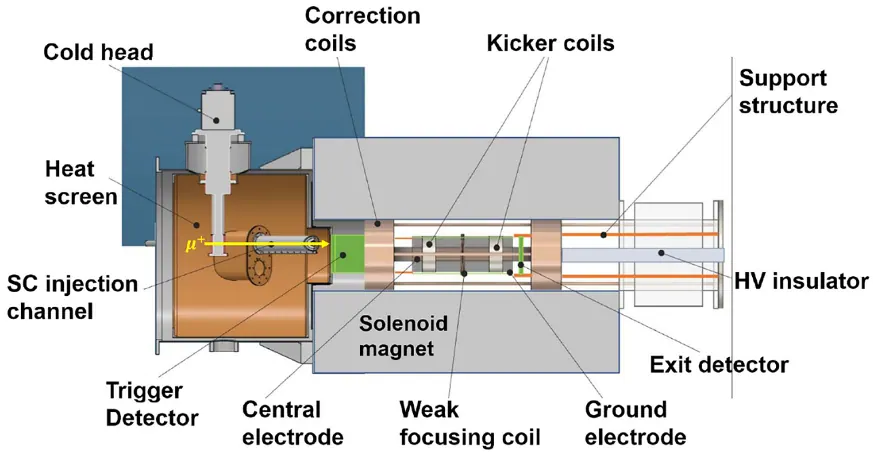
Fig. 1 – Schematic of the muEDM setup.
In preparation for the experiment’s Phase I, we have developed and validated a fast muon trigger detector and its front-end electronics, essential for capturing muons entering the storage solenoid and synchronizing the activation of a pulsed magnetic kicker.
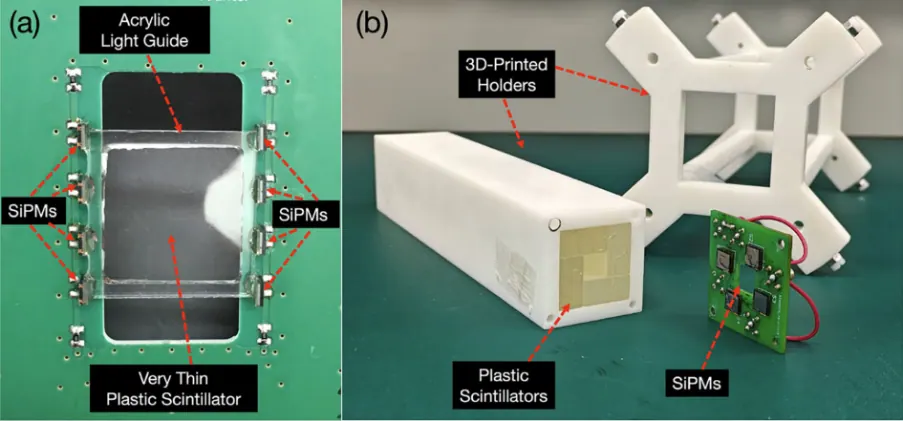
The first study, reported in Radiation Detection Technology and Methods (2025), describes the design and beam testing of a prototype trigger detector consisting of a 100 µm-thin gate scintillator and a surrounding telescope array, both read out by silicon photomultipliers (SiPMs). Using 27.5 MeV/c muons at PSI’s πE1 beamline, the team observed high timing precision, optimal light yield, and excellent agreement with Geant4 simulations, confirming the system’s ability to select storable muons while rejecting background particles.
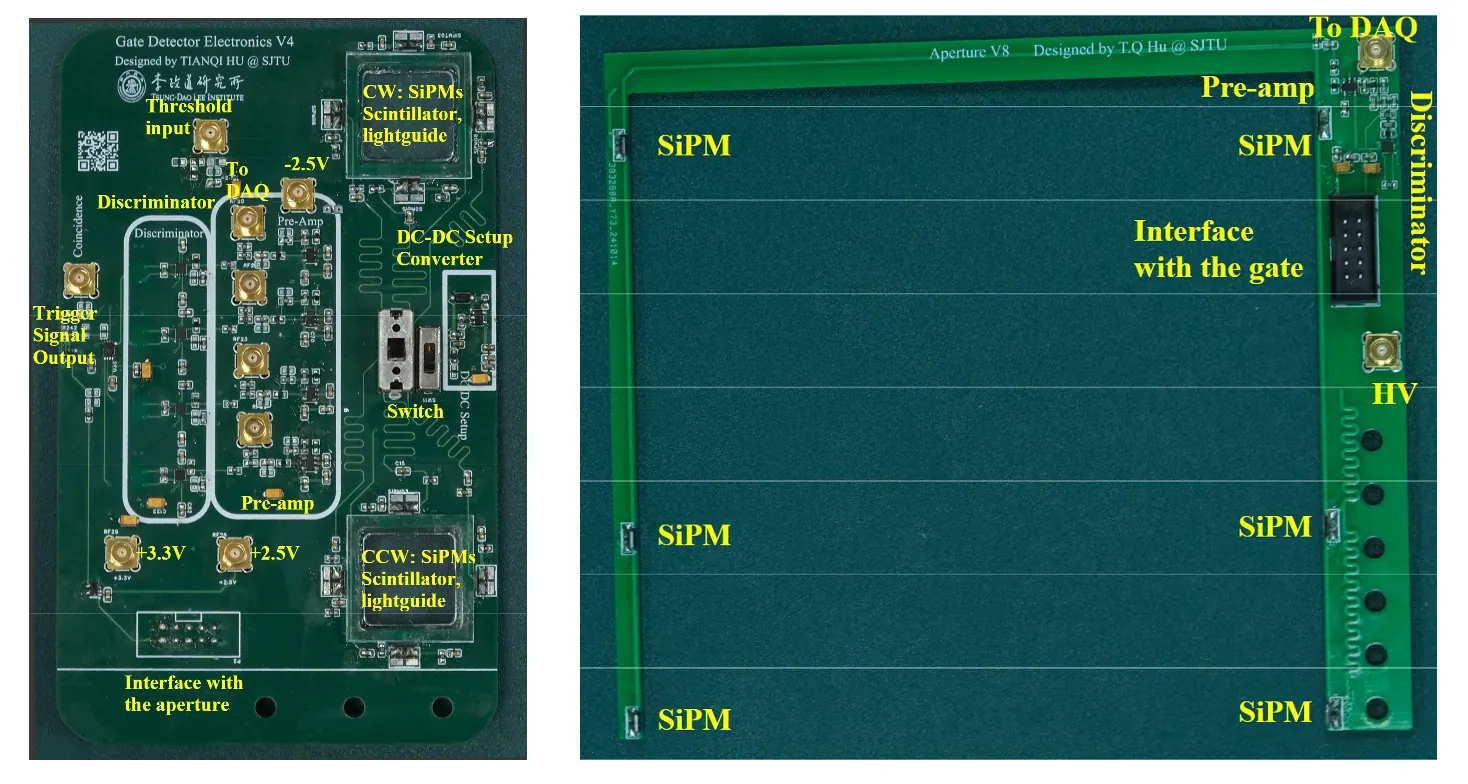
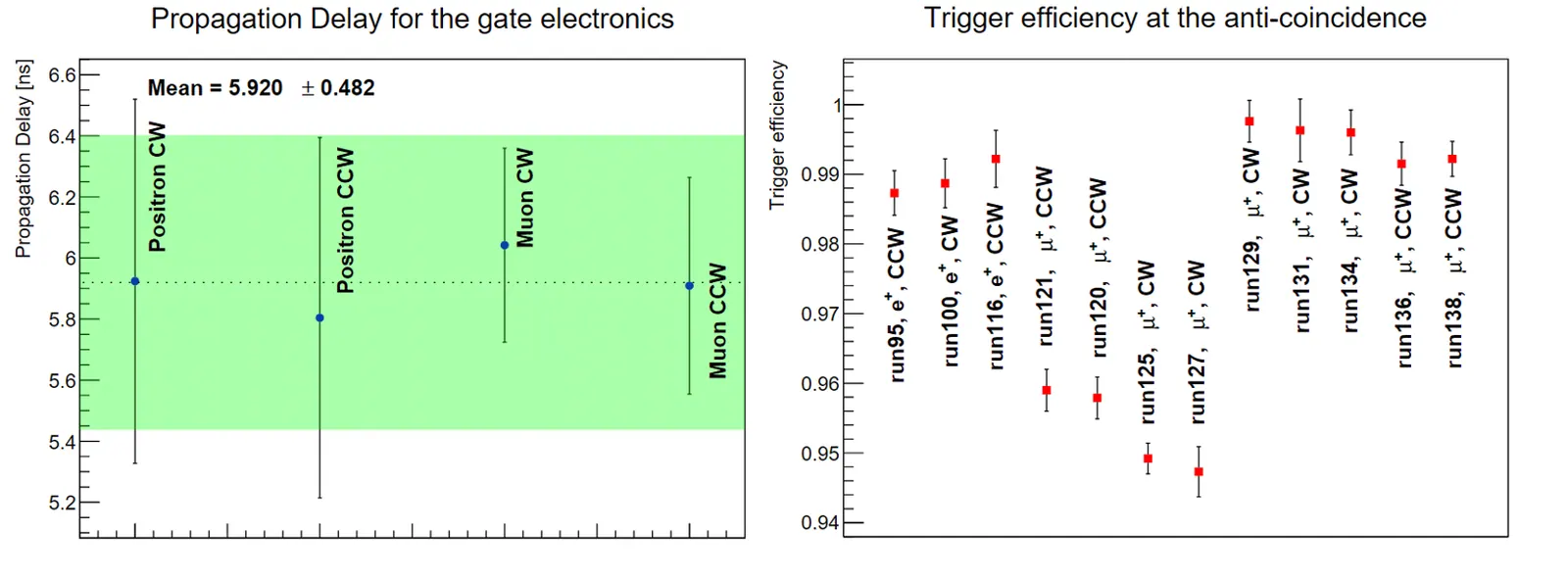
Building on this foundation, the collaboration developed fast front-end readout electronics, presented in IEEE Transactions on Nuclear Science (2025). The compact system integrates preamplifiers, discriminators, and anti-coincidence logic operating inside a 3 T magnetic field, achieving a total signal latency below 15 ns. During beam tests, the electronics demonstrated sub-6 ns propagation delay and >99 % anti-coincidence efficiency, validating performance under experimental conditions.
With both detector and electronics prototypes now validated, installation and commissioning for Phase I of the muEDM experiment are underway at PSI, bringing researchers a step closer to uncovering new sources of CP violation.
两项最新研究标志着向世界最灵敏的缪子电偶极矩搜寻迈出关键步伐。
PSI muEDM实验旨在将缪子电偶极矩(EDM)的探测灵敏度提升至6 × 10⁻²³ e·cm——比现有上限高出四个数量级,以此探索超出标准模型的新物理。一旦探测到非零EDM,将揭示新的CP破坏来源,为理解宇宙中的正反物质不对称提供线索。
图1 – muEDM实验装置示意图。
为实验第一阶段做准备,我们研制并验证了快速缪子触发探测器及其前端电子学。该系统用于捕获进入储存螺线管的缪子,并同步触发脉冲磁冲击器(kicker)。
第一项研究发表于Radiation Detection Technology and Methods(2025),介绍了原型触发探测器的设计与束流测试。该探测器由厚度仅100 µm的门控闪烁体及其周围的望远镜阵列组成,均采用硅光电倍增管(SiPM)读出。团队在PSI的πE1束流线上利用27.5 MeV/c缪子开展测试,获得了很高的时间精度和理想的光产额,结果与Geant4模拟高度吻合,证实该系统能够在排除本底粒子的同时选出可被储存的缪子。
在此基础上,合作组进一步研制了快速前端读出电子学,相关成果发表于IEEE Transactions on Nuclear Science(2025)。该紧凑型系统集成了前置放大器、甄别器和反符合逻辑,可在3 T磁场中工作,总信号延迟低于15 ns。束流测试中,该电子学系统实现了低于6 ns的传播延迟和>99 %的反符合效率,验证了其在实验条件下的性能。
随着探测器和电子学原型均已通过验证,muEDM实验第一阶段的安装与调试工作正在PSI推进,研究人员距离发现新的CP破坏来源又近了一步。