04/07About Muons缪子科普
Muon Detection Techniques缪子探测技术
Muons are invisible, silent and gone in microseconds — so how do we know they are there? Every muon detector relies on the same idea: as a fast charged particle passes through matter, it knocks electrons off atoms and leaves a trail of energy behind. Turn that trail into light or an electrical pulse, and you can count muons, time them, track them and even read their spin.
缪子看不见、听不到,几微秒就消失了——我们怎么知道它们存在?所有缪子探测器都基于同一个原理:高速带电粒子穿过物质时会把原子中的电子打出来,沿途留下能量的“足迹”。把这条足迹转化为光或电脉冲,就能对缪子计数、计时、追踪其径迹,甚至读出它的自旋。
How muons leave a trace缪子如何留下痕迹
- Ionisation. A typical cosmic muon loses about 2 MeV for every centimetre of water it crosses (the Bethe–Bloch formula describes this precisely). It is a “minimum-ionising particle”: it deposits little energy, so it travels a long way — through metres of rock.
- 电离。典型的宇宙线缪子每穿过1厘米水约损失2 MeV能量(贝特—布洛赫公式可精确描述)。它是“最小电离粒子”:沉积的能量很少,因此能走得很远——穿透数米岩石。
- Multiple scattering. Each nucleus it passes gives the muon a tiny sideways kick. Dense, high-atomic-number materials like lead or uranium kick harder — the basis of scattering muography.
- 多次散射。经过的每个原子核都会给缪子一个微小的侧向偏折。铅、铀等高密度、高原子序数的材料偏折更强——这正是散射型缪子成像的基础。
- Decay. A muon that stops in a detector decays after about 2.2 μs, emitting an electron or positron whose direction reveals the muon's spin.
- 衰变。停在探测器中的缪子约2.2微秒后衰变,发射出的电子或正电子的方向能揭示缪子的自旋。
- Cherenkov light. A muon moving faster than light travels in water (about 75% of c) emits a cone of blue light — an optical “sonic boom”.
- 切伦科夫光。当缪子在水中的速度超过光在水中的速度(约光速的75%)时,会发出一个蓝色光锥——光学上的“音爆”。
Scintillators: turning muons into flashes of light闪烁体:把缪子变成闪光
A scintillator is a material — often a plastic doped with fluorescent molecules, or an inorganic crystal — that gives off a short flash of light when a charged particle passes through it. A photodetector turns the flash into an electrical pulse: traditionally a photomultiplier tube (PMT), and increasingly a silicon photomultiplier (SiPM), a fingernail-sized chip that works at low voltage and in magnetic fields.
闪烁体是一种材料——通常是掺有荧光分子的塑料或无机晶体——带电粒子穿过时会发出短暂的闪光。光电探测器把闪光转换为电脉冲:传统上用光电倍增管(PMT),如今越来越多地使用硅光电倍增管(SiPM)——一种指甲大小的芯片,工作电压低,且能在磁场中工作。
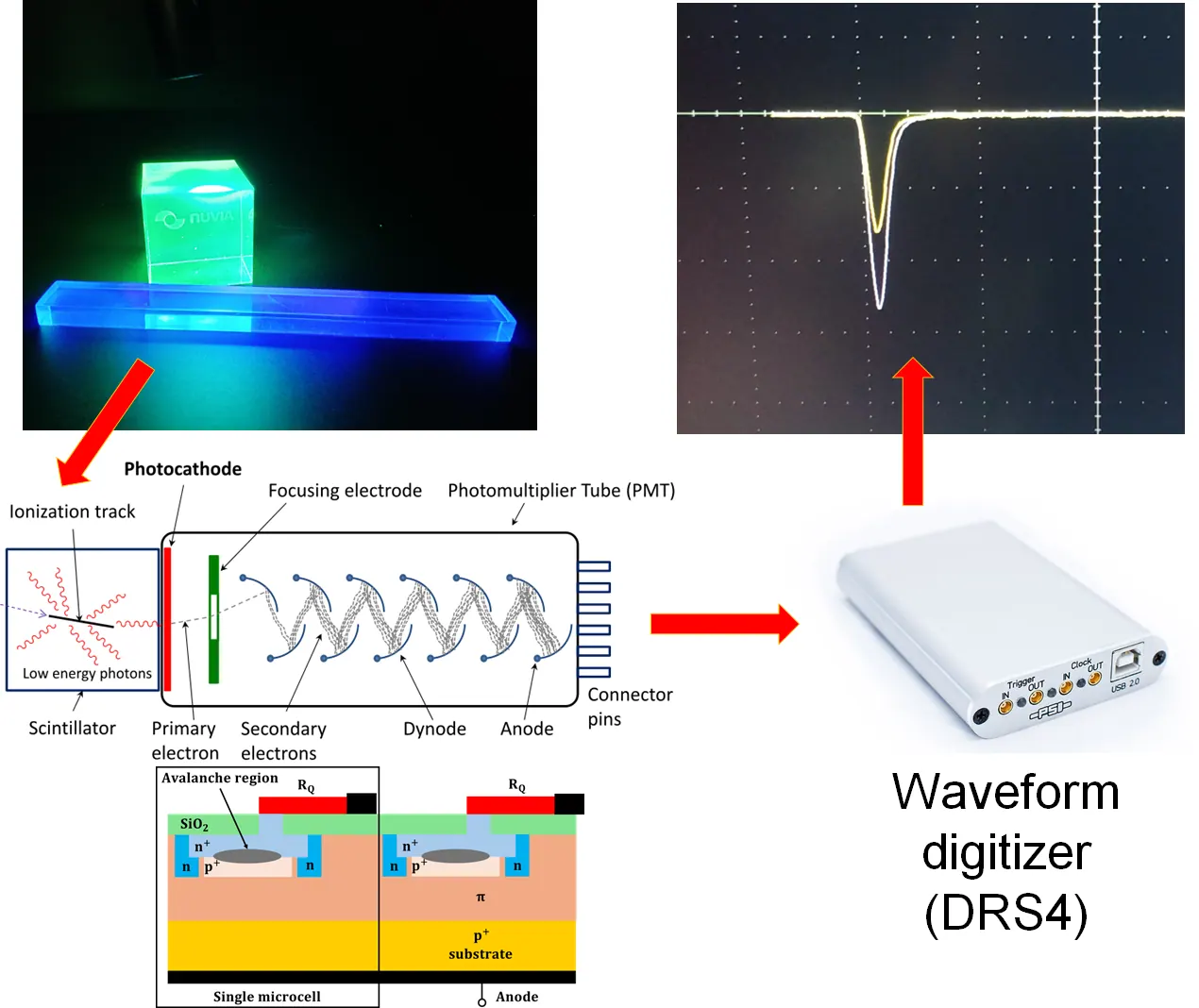
Scintillators respond within nanoseconds, are robust and cheap, and can be cut into bars, tiles or thin fibres. That is why they are everywhere: in desktop CosmicWatch counters, in the muon trigger our group builds for muEDM, and in our muography systems — the Cosmic-ray Muography System uses layers of triangular scintillator bars read out by SiPMs, and the SciFi-MST design uses scintillating fibres.
闪烁体响应时间为纳秒量级,坚固且成本低,可切割成条、块或细光纤,因此应用极其广泛:桌面式 CosmicWatch 计数器、本课题组为 muEDM 研制的缪子触发探测器,以及我们的缪子成像系统——宇宙线缪子成像系统(CMS)采用由SiPM读出的三角形闪烁体条,SciFi-MST 方案则采用闪烁光纤。
Inorganic crystals such as lead fluoride (PbF2) or lutetium-based crystals are dense and measure particle energies: the Muon g−2 experiment uses 1,296 PbF2 crystals read by SiPMs to measure every decay positron.
氟化铅(PbF2)、镥基晶体等无机晶体密度高,可测量粒子能量:Muon g−2 实验使用1296块由SiPM读出的 PbF2 晶体来测量每一个衰变正电子。
Gaseous detectors: following the track气体探测器:追踪径迹
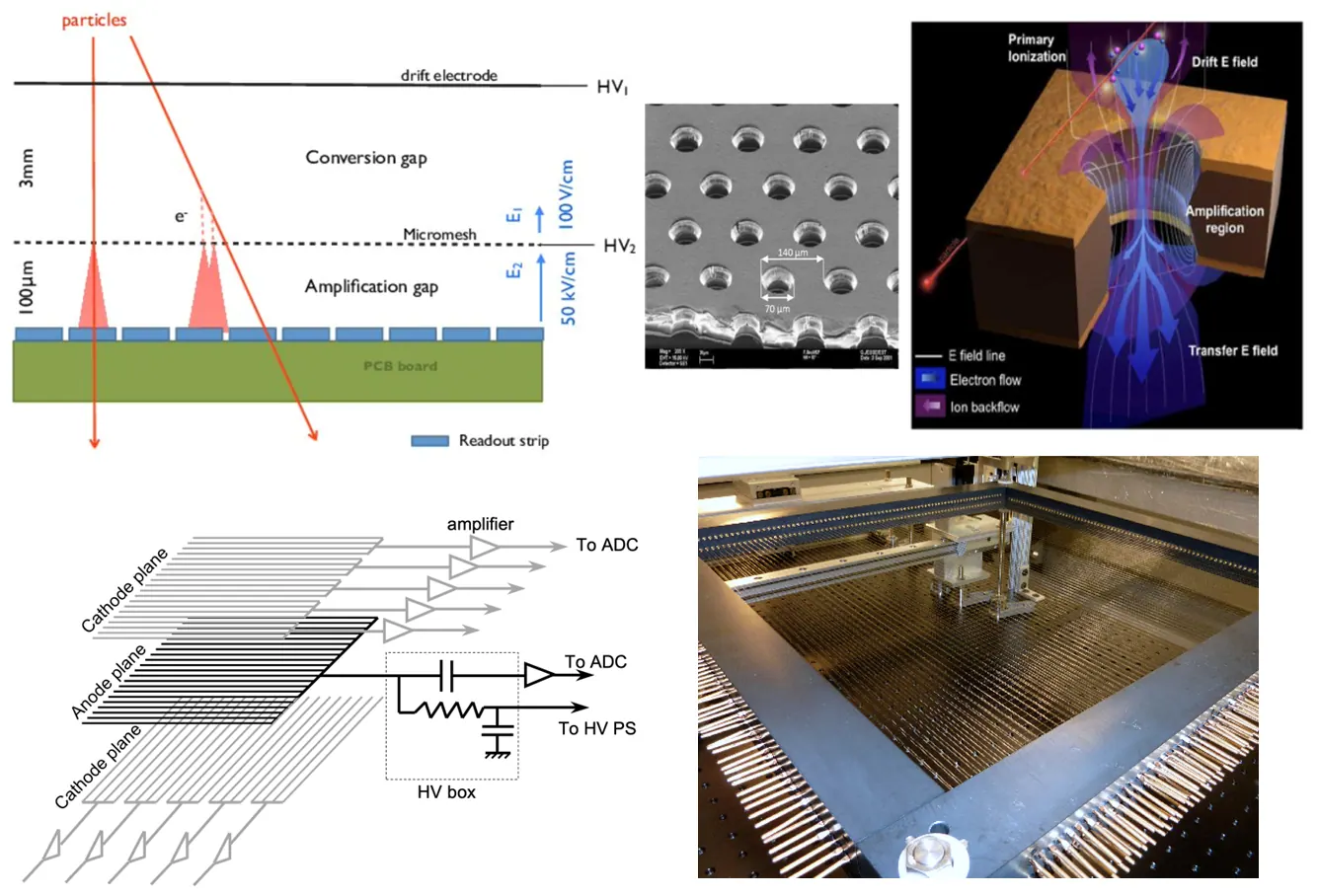
In a gaseous detector, the electrons knocked free by a muon drift towards thin wires or fine meshes held at high voltage. Near the wire the electric field is so strong that each electron triggers an avalanche of thousands more, producing a measurable signal. Knowing which wire fired and when tells us where the muon passed.
在气体探测器中,被缪子电离出的电子向加有高电压的细丝或细网漂移。在丝附近,电场强到每个电子都能引发数千个电子的“雪崩”,形成可测量的信号。根据哪根丝在何时响应,就能确定缪子经过的位置。
- Geiger counters — the classic “click” detector, simple but without position information.
- 盖革计数器——经典的“咔哒”探测器,结构简单,但不给出位置信息。
- Multi-wire proportional and drift chambers — invented by Georges Charpak (Nobel Prize 1992), they made electronic particle tracking possible.
- 多丝正比室与漂移室——由夏帕克(Georges Charpak,1992年诺贝尔物理学奖)发明,使粒子径迹的电子学测量成为可能。
- Micro-pattern detectors — Micromegas, GEMs and resistive plate chambers (RPCs) give sub-millimetre position resolution over large areas at modest cost, ideal for large muography panels.
- 微结构气体探测器——Micromegas、GEM 和阻性板室(RPC)能以适中成本在大面积上实现亚毫米位置分辨,非常适合大型缪子成像探测面板。
- Time projection chambers — record a full 3D picture of each track in a large gas volume.
- 时间投影室——在大体积气体中记录每条径迹的完整三维图像。
Silicon detectors: the finest detail硅探测器:最精细的细节
Thin silicon sensors divided into strips or millions of pixels locate a particle to a few micrometres. For low-energy muon decays, every gram of material scatters the electrons, so the Mu3e experiment at PSI uses pixel sensors thinned to just 50 micrometres — thinner than a human hair — cooled by gaseous helium.
分割成微条或数百万像素的薄硅传感器,可将粒子位置确定到几微米。对于低能缪子衰变,每一克材料都会散射电子,因此PSI的 Mu3e 实验使用仅50微米厚(比头发还细)的像素传感器,并用氦气冷却。
Cherenkov detectors: seeing the cone切伦科夫探测器:看见光锥
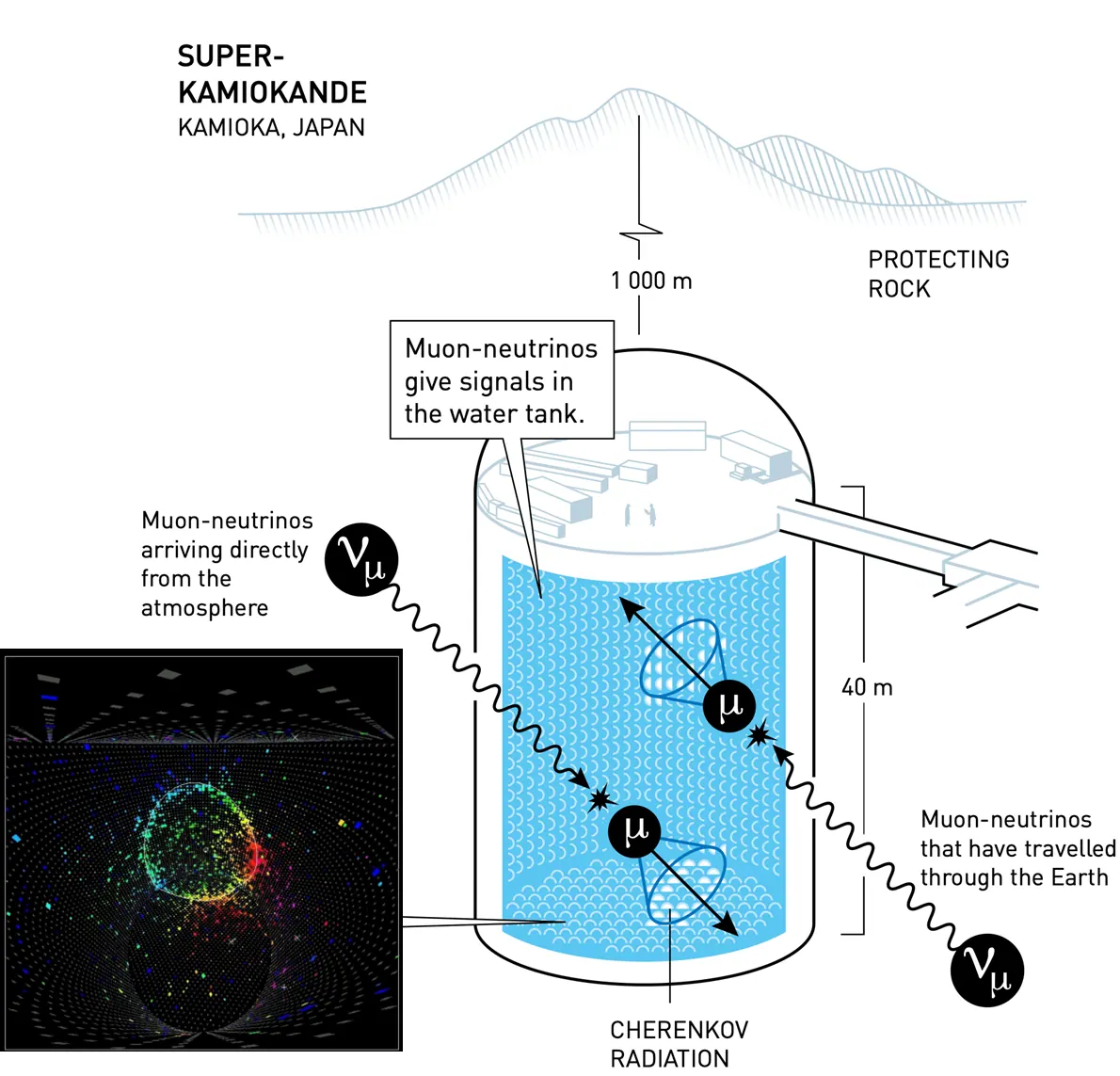
Huge tanks of ultra-pure water lined with photomultipliers catch the ring of Cherenkov light a muon makes. The size, sharpness and orientation of the ring reveal the particle's direction and type. Giant neutrino observatories such as Super-Kamiokande in Japan, and IceCube buried in Antarctic ice, identify muons this way — muons produced by neutrinos are one of their main signals.
装满超纯水、内壁布满光电倍增管的巨大水箱,可以捕获缪子产生的切伦科夫光环。光环的大小、清晰度和方向揭示了粒子的方向与种类。日本超级神冈、南极冰层中的 IceCube 等大型中微子观测站正是这样识别缪子——由中微子产生的缪子是它们的主要信号之一。
Nuclear emulsion: photographic film for particles核乳胶:粒子的“照相底片”
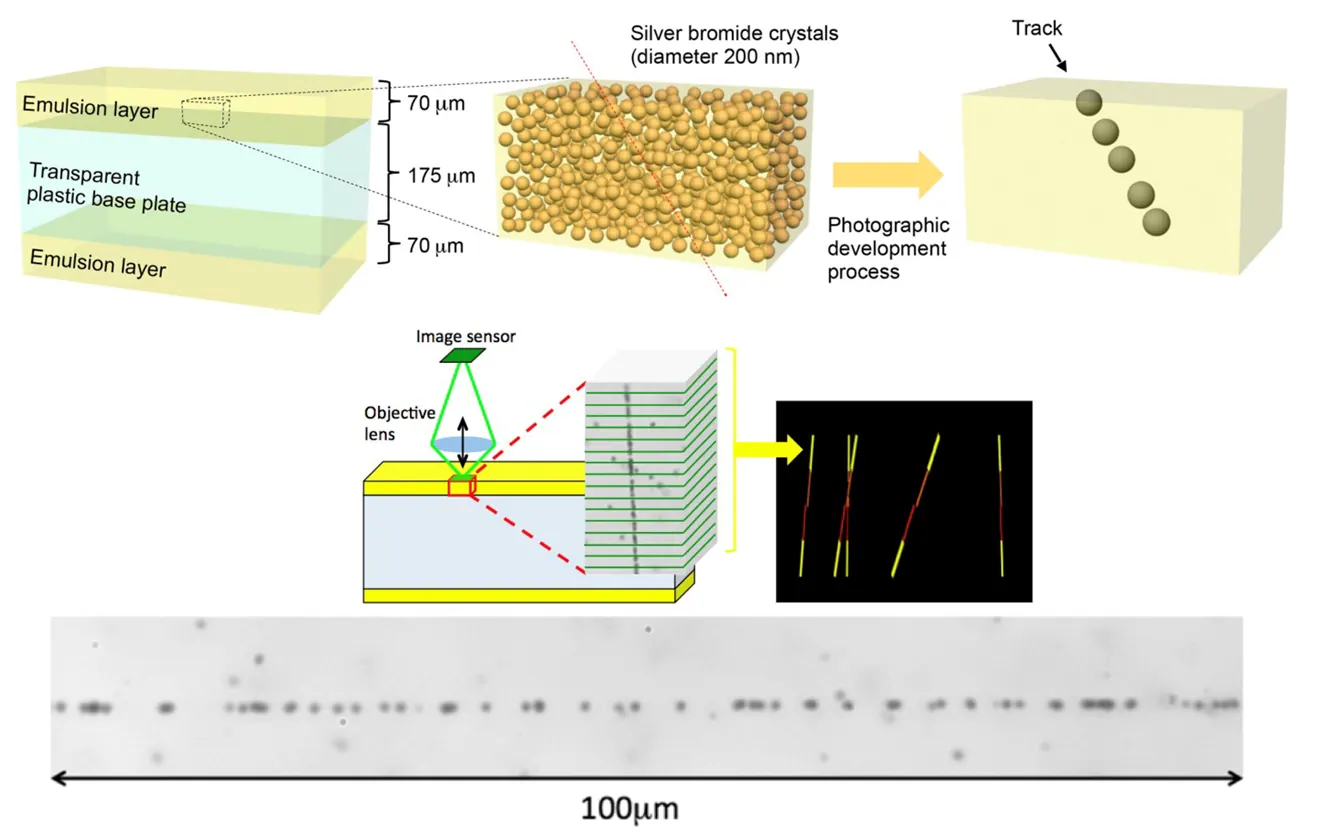
Nuclear emulsion is a thick photographic film. A passing charged particle leaves a line of silver grains that appears after development. Emulsion captured the decay of a pion into a muon in 1947 and helped clarify the muon's identity. Today, automated microscopes scan emulsion films at high speed with sub-micrometre precision. Because the films need no power and are light and portable, they were used by the ScanPyramids team to discover the hidden void in the Great Pyramid.
核乳胶是一种厚的照相胶片,带电粒子穿过后会留下一串银颗粒,冲洗后即可看到。1947年,核乳胶记录下了π介子衰变为缪子的过程,帮助人们认清了缪子的身份。如今,自动化显微镜能以亚微米精度高速扫描乳胶片。由于乳胶片无需供电、轻便易携带,ScanPyramids 团队就用它发现了大金字塔中的隐藏空腔。
Choosing a detector如何选择探测器
| Technology技术 | Strength优势 | Typical use典型用途 |
|---|---|---|
| Plastic scintillator + SiPM塑料闪烁体 + SiPM | Fast (ns), robust, low cost快(纳秒级)、坚固、低成本 | Triggers, timing, outreach counters, muography触发、计时、科普计数器、缪子成像 |
| Crystal calorimeter晶体量能器 | Energy measurement能量测量 | Muon g−2, MEG II |
| Gaseous detectors气体探测器 | Large area, sub-mm tracking大面积、亚毫米径迹 | Muon systems at colliders, muography对撞机缪子系统、缪子成像 |
| Silicon pixels/strips硅像素/微条 | Micrometre precision, low mass微米精度、低物质量 | Mu3e, vertex detectors顶点探测器 |
| Water/ice Cherenkov水/冰切伦科夫 | Enormous volume, direction体积巨大、可测方向 | Neutrino observatories中微子观测站 |
| Nuclear emulsion核乳胶 | Sub-μm resolution, no power亚微米分辨、无需供电 | Archaeology, volcano muography考古、火山缪子成像 |
Want to see how a detector responds before building one? Our free online course From Track to Truth teaches Geant4 simulation of muon detectors step by step.
想在动手搭建前了解探测器的响应?我们免费的在线课程《从径迹到真相》手把手讲授缪子探测器的Geant4模拟。
References参考文献
- S. Gundacker & A. Heering, “The silicon photomultiplier: fundamentals and applications of a modern solid-state photon detector,” Phys. Med. Biol. 65, 17TR01 (2020). doi:10.1088/1361-6560/ab7b2d
- K. S. Khaw et al. (Muon g−2), “Performance of the Muon g−2 calorimeter and readout systems measured with test beam data,” Nucl. Instrum. Meth. A 945, 162558 (2019). doi:10.1016/j.nima.2019.162558
- S. N. Axani et al., “CosmicWatch: the desktop muon detector (v3X),” JINST 20, P10040 (2025). doi:10.1088/1748-0221/20/10/P10040
- G. Charpak et al., “The use of multiwire proportional counters to select and localize charged particles,” Nucl. Instrum. Meth. 62, 262 (1968). doi:10.1016/0029-554X(68)90371-6
- M. Titov, “New developments and future perspectives of gaseous detectors,” Nucl. Instrum. Meth. A 581, 25 (2007). doi:10.1016/j.nima.2007.07.022
- P. Fonte & V. Peskov, “On the physics and technology of gaseous particle detectors,” Plasma Sources Sci. Technol. 19, 034021 (2010). doi:10.1088/0963-0252/19/3/034021
- Mu3e Collaboration (K. Arndt et al.), “Technical design of the phase I Mu3e experiment,” Nucl. Instrum. Meth. A 1014, 165679 (2021). doi:10.1016/j.nima.2021.165679
- Y. Suzuki, “The Super-Kamiokande experiment,” Eur. Phys. J. C 79, 298 (2019). doi:10.1140/epjc/s10052-019-6796-2
- K. Morishima et al., “Discovery of a big void in Khufu's Pyramid by observation of cosmic-ray muons,” Nature 552, 386 (2017). doi:10.1038/nature24647
- Particle Data Group, “Passage of particles through matter, Review of Particle Physics,”. pdg.lbl.gov