06/07About Muons缪子科普
Muonium缪子素
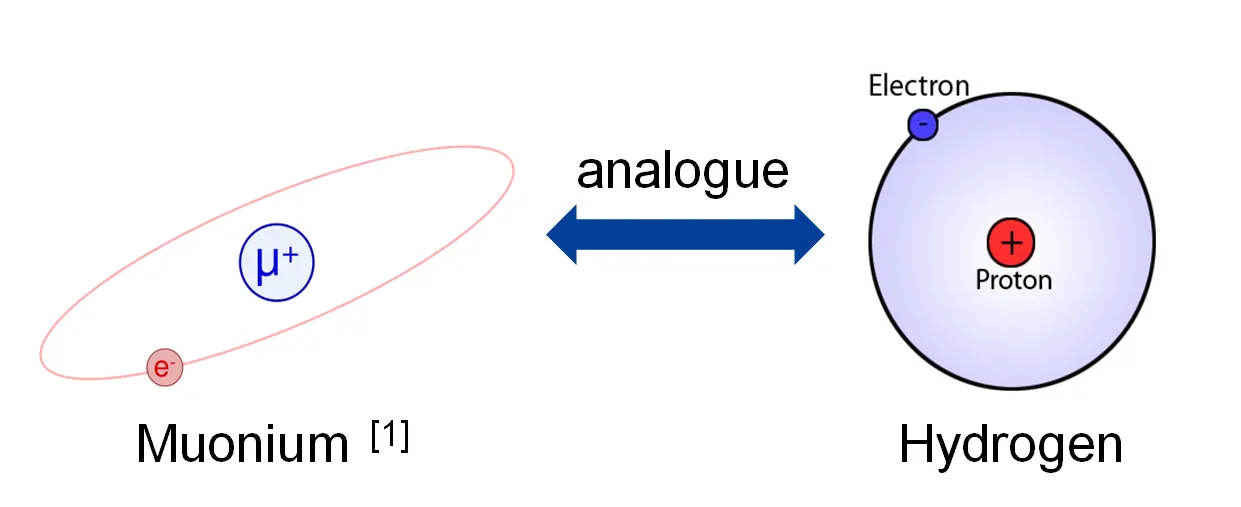
Take a hydrogen atom and replace its proton with a positive muon. You get muonium — an atom with no nucleus in the usual sense, made only of two leptons. It lives just 2.2 microseconds, yet it is one of the cleanest systems in all of physics for testing quantum theory, matter–antimatter symmetry and even how antimatter falls under gravity.
把氢原子中的质子换成正缪子,就得到了缪子素——一种没有通常意义上原子核、仅由两个轻子组成的原子。它只能存活2.2微秒,却是物理学中检验量子理论、物质—反物质对称性,乃至反物质如何在引力下“下落”的最纯净体系之一。
What is muonium?什么是缪子素?
Muonium (chemical symbol Mu) is a bound state of a positive muon μ+ and an electron e−. It was discovered in 1960 by Vernon Hughes and colleagues, who saw the characteristic precession of muonium's spin in argon gas.
缪子素(化学符号 Mu)是正缪子 μ+ 与电子 e− 的束缚态。1960年,休斯(Vernon Hughes)及其同事在氩气中观测到缪子素自旋的特征进动,从而发现了它。
Because the muon is still 207 times heavier than the electron, muonium has almost the same size and chemistry as hydrogen. Chemists treat it as a very light hydrogen isotope, and use it to study how hydrogen atoms react, tunnel and bind — especially in semiconductors, where isolated hydrogen is hard to observe directly.
由于缪子仍比电子重207倍,缪子素的大小和化学性质几乎与氢相同。化学家把它当作一种极轻的氢同位素,用来研究氢原子如何反应、隧穿和成键——在孤立氢原子难以直接观测的半导体中尤其有用。
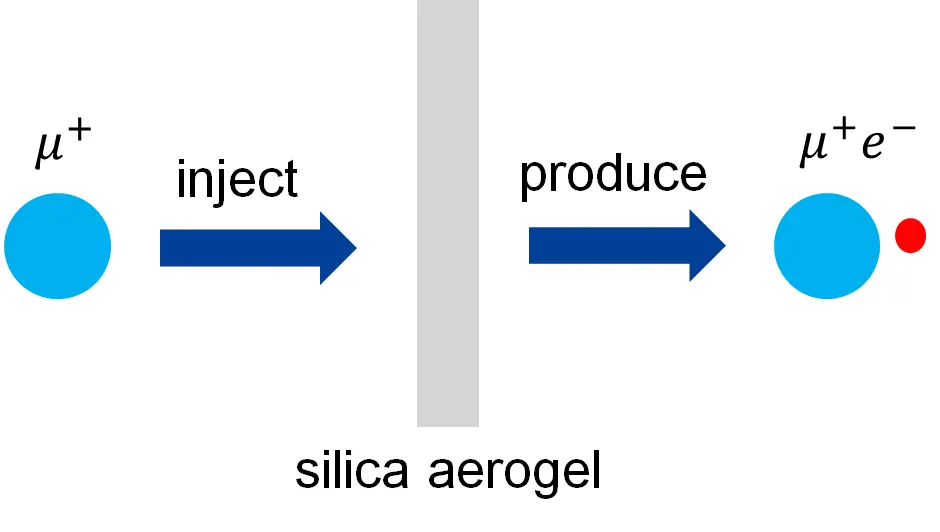
Muonium is made by stopping a beam of positive muons in a material where they can pick up an electron. In silica powder or laser-drilled silica aerogel, some muonium atoms diffuse out of the surface into vacuum, where they can be studied free of any surrounding material. A newer approach produces a cold muonium beam from superfluid helium.
将正缪子束停在能让它们俘获电子的材料中,即可产生缪子素。在二氧化硅粉末或激光打孔的二氧化硅气凝胶中,部分缪子素会从表面扩散到真空中,从而可以在不受周围物质影响的情况下进行研究。一种较新的方法则是利用超流氦产生冷缪子素束。
Why study muonium?为什么研究缪子素?
A perfect test of quantum electrodynamics量子电动力学的完美检验
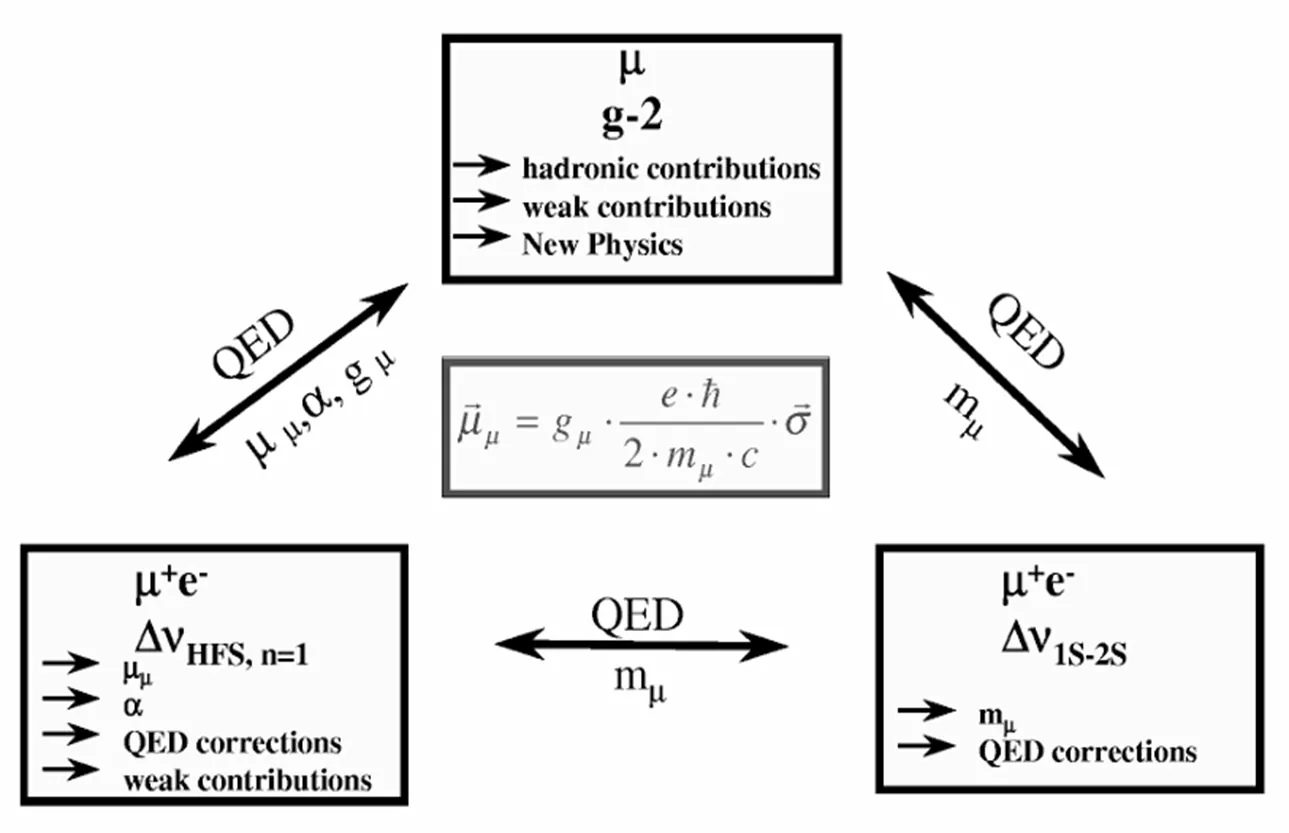
Hydrogen is the textbook atom, but its proton is a messy object made of quarks and gluons, and its size limits how precisely theory can predict hydrogen's energy levels. Muonium has no such problem: both the muon and electron are, as far as we know, point-like. Its energy levels can be calculated almost entirely from quantum electrodynamics (QED), so comparing theory and experiment is an exceptionally clean test.
氢是教科书中的标准原子,但其质子是由夸克和胶子构成的复杂对象,质子的大小限制了理论预言氢原子能级的精度。缪子素没有这个问题:就目前所知,缪子和电子都是点粒子,其能级几乎完全可以由量子电动力学(QED)计算,因此理论与实验的比较格外纯净。
- Ground-state hyperfine splitting (about 4.463 GHz): the energy difference between the muon and electron spins being parallel or opposite. Measured to 12 parts per billion at Los Alamos in 1999; it gives the muon's mass and magnetic moment, an essential input to the Muon g−2 experiment. The MuSEUM experiment at J-PARC aims to improve it further.
- 基态超精细分裂(约4.463 GHz):缪子与电子自旋平行与反平行时的能量差。1999年在洛斯阿拉莫斯测量精度达十亿分之12;它给出了缪子的质量和磁矩,是 Muon g−2 实验的重要输入量。J-PARC 的 MuSEUM 实验正致力于进一步提高精度。
- 1S–2S transition: measured by two-photon laser spectroscopy, it determines the ratio of the electron and muon masses. The Mu-MASS project at PSI aims to improve it by about a thousand times.
- 1S—2S 跃迁:通过双光子激光光谱测量,可确定电子与缪子的质量比。PSI 的 Mu-MASS 项目目标是将精度提高约一千倍。
- Lamb shift: a tiny splitting of the n = 2 levels caused by vacuum fluctuations, recently measured in muonium at PSI.
- 兰姆位移:由真空涨落引起的 n = 2 能级的微小分裂,近期已在PSI对缪子素进行了测量。
Matter–antimatter symmetry (CPT)物质—反物质对称性(CPT)
The CPT theorem says that the laws of physics are unchanged if you swap particles for antiparticles, mirror space and reverse time together. Comparing the 1S–2S transition of muonium with that of antimuonium (μ−e+), or measuring muonium's energy levels as the Earth rotates, can reveal tiny violations of CPT or Lorentz symmetry.
CPT定理指出:同时交换粒子与反粒子、镜像翻转空间并反转时间,物理规律保持不变。比较缪子素与反缪子素(μ−e+)的 1S—2S 跃迁,或随地球自转测量缪子素能级,可以揭示CPT或洛伦兹对称性的微小破缺。
Can muonium turn into antimuonium?缪子素能变成反缪子素吗?
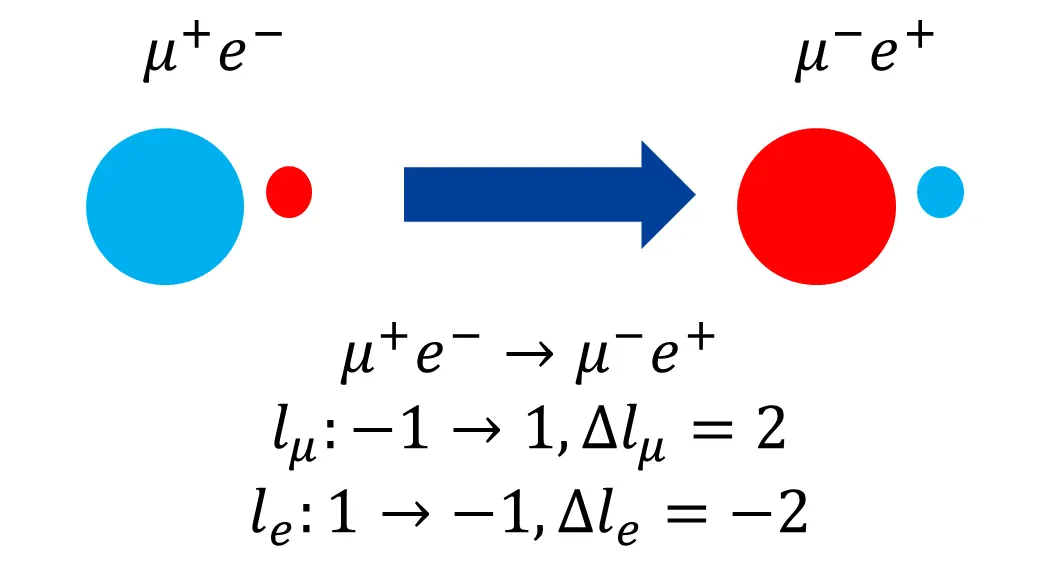
In muonium-to-antimuonium conversion, μ+e− spontaneously becomes μ−e+. This changes the muon number and the electron number each by two units — a form of charged lepton flavour violation that is forbidden in the Standard Model, but predicted by several theories with doubly charged Higgs bosons or heavy neutral leptons.
在缪子素—反缪子素转换中,μ+e− 自发变为 μ−e+。这一过程使缪子数和电子数各改变两个单位——是一种被标准模型禁戒的带电轻子味破坏,但若干包含双电荷希格斯粒子或重中性轻子的理论预言它可能发生。
- Current limit: the MACS experiment at PSI (1999) found the conversion probability is below 8.3 × 10⁻¹¹ (90% confidence).
- 现有上限:PSI的MACS实验(1999年)给出转换概率小于 8.3 × 10⁻¹¹(90%置信度)。
- MACE: the proposed Muonium-to-Antimuonium Conversion Experiment in China aims to be sensitive to probabilities around 10−13 — about a hundred times better. It would detect the energetic electron from the μ− decay together with the slow positron left behind.
- MACE:中国提出的缪子素—反缪子素转换实验(MACE)目标灵敏度约为 10−13——提高约一百倍。它将同时探测 μ− 衰变产生的高能电子以及残留的慢正电子。
Does antimatter fall down? Muonium and gravity反物质会“往下掉”吗?缪子素与引力
Almost everything we know about gravity comes from ordinary matter. Muonium offers a rare chance to test gravity on antimatter — its mass is dominated by the antimuon μ+ — and on a particle from the second generation. Because muonium contains no quarks, it tests gravity on purely leptonic matter.
我们对引力的认识几乎全部来自普通物质。缪子素提供了一个难得的机会,用以检验引力对反物质的作用——它的质量主要来自反缪子 μ+——同时也检验引力对第二代粒子的作用。由于缪子素不含夸克,它检验的是纯轻子物质所受的引力。
- One approach searches for an annual modulation of muonium's 1S–2S frequency as the Earth's distance from the Sun changes.
- 一种方法是寻找缪子素 1S—2S 频率随地日距离变化而出现的年度调制。
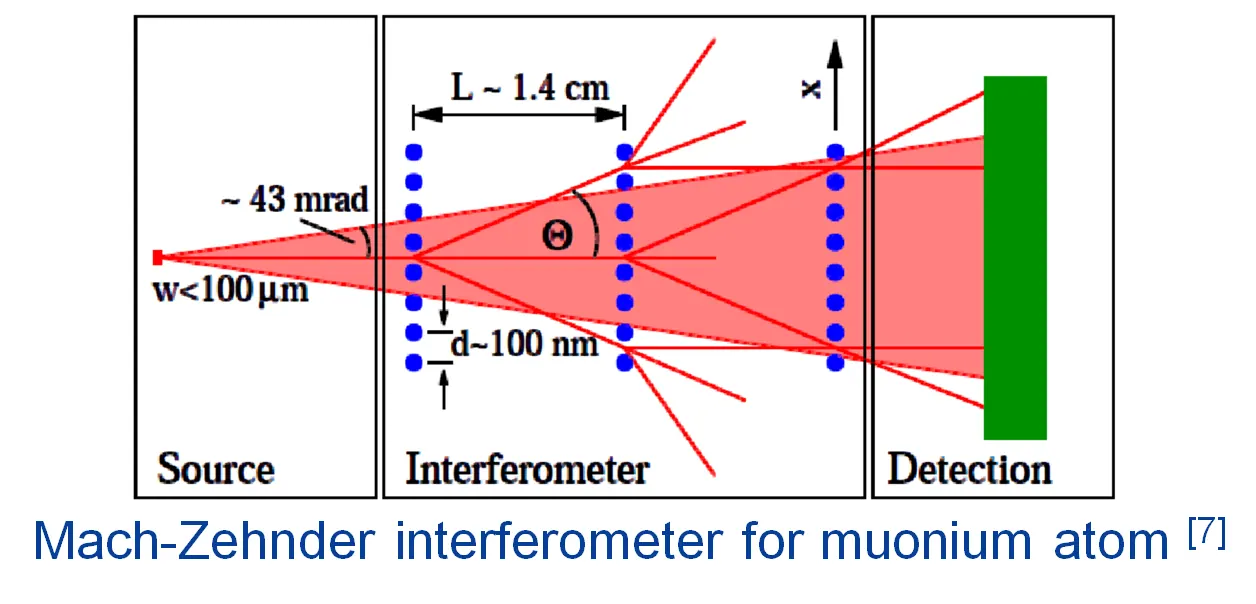
- Another sends a high-quality beam of muonium through a Mach–Zehnder atom interferometer and measures how much it falls in a few microseconds — a drop of only around a tenth of a nanometre, smaller than an atom, which demands extraordinary precision. This idea, proposed by K. Kirch and K. S. Khaw in 2014, is being pursued by the LEMING collaboration at PSI.
- 另一种方法是让高品质缪子素束穿过马赫—曾德尔原子干涉仪,测量它在几微秒内下落的距离——仅约十分之一纳米,比一个原子还小,需要极高的精度。这一方案由 K. Kirch 与 K. S. Khaw(许金祥)于2014年提出,目前PSI的 LEMING 合作组正在推进。
References参考文献
- V. W. Hughes et al., “Formation of muonium and observation of its Larmor precession,” Phys. Rev. Lett. 5, 63 (1960). doi:10.1103/PhysRevLett.5.63
- W. Liu et al., “High precision measurements of the ground state hyperfine structure interval of muonium and of the muon magnetic moment,” Phys. Rev. Lett. 82, 711 (1999). doi:10.1103/PhysRevLett.82.711
- V. Meyer et al., “Measurement of the 1s–2s energy interval in muonium,” Phys. Rev. Lett. 84, 1136 (2000). doi:10.1103/PhysRevLett.84.1136
- G. Janka et al., “Measurement of the transition frequency from 2S₁/₂, F = 0 to 2P₁/₂, F = 1 states in muonium,” Nat. Commun. 13, 7273 (2022). doi:10.1038/s41467-022-34672-0
- M. Otani, “Muon cooling and acceleration,” AAPPS Bull. 32, 6 (2022). doi:10.1007/s43673-022-00035-6
- A. H. Gomes, V. A. Kostelecký & A. J. Vargas, “Laboratory tests of Lorentz and CPT symmetry with muons,” Phys. Rev. D 90, 076009 (2014). doi:10.1103/PhysRevD.90.076009
- L. Willmann et al., “New bounds from searching for muonium to antimuonium conversion,” Phys. Rev. Lett. 82, 49 (1999). doi:10.1103/PhysRevLett.82.49
- L. Willmann & K. Jungmann, “Muonium–antimuonium conversion,” SciPost Phys. Proc. 5, 009 (2021). doi:10.21468/SciPostPhysProc.5.009
- A.-Y. Bai et al., “Conceptual design of the muonium-to-antimuonium conversion experiment (MACE),” Nucl. Sci. Tech. 37, 57 (2026). doi:10.1007/s41365-025-01876-0
- K. Kirch & K. S. Khaw, “Testing antimatter gravity with muonium,” Int. J. Mod. Phys. Conf. Ser. 30, 1460258 (2014). doi:10.1142/S2010194514602580