One year after its final measurement of the muon magnetic anomaly, the Muon g-2 Collaboration at Fermilab has reported a new search for a different property of the muon: its electric dipole moment (EDM). An EDM would mean a tiny, permanent separation of positive and negative charge inside the muon. Because it violates time-reversal and charge-parity (CP) symmetry, the Standard Model predicts a value of about 10−38 e·cm, far below any experimental reach. Seeing a non-zero muon EDM would therefore be an unambiguous sign of new physics, and a possible new source of the CP violation needed to explain why the universe is made of matter.
The experiment searches for the EDM almost for free, using the same data as the g-2 analysis. The magnetic moment drives the familiar horizontal precession of the muon spin; an EDM would tilt the precession plane and add a small vertical oscillation to the decay positrons. The straw-tracker stations measured the average vertical angle of these positrons, using data from Runs 2 and 3 (2019–2020), about a quarter of the full Fermilab dataset.
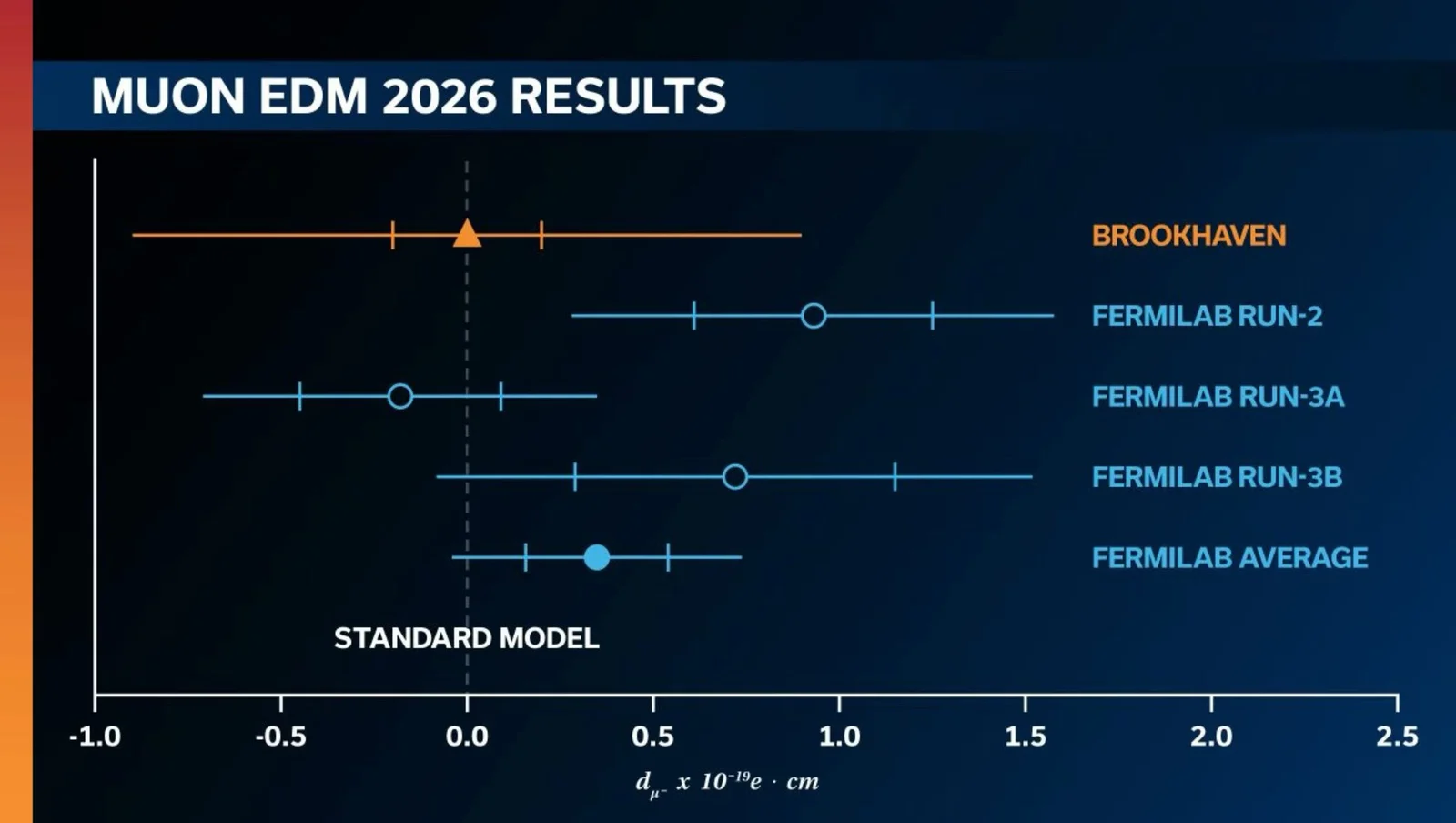
No EDM was found. The result, dμ = (−0.35 ± 0.19stat ± 0.34sys) × 10−19 e·cm, is consistent with zero and sets a new direct limit of |dμ| < 1.1 × 10⁻¹⁹ e·cm at 95% confidence level. This is about 1.5 times more stringent than the long-standing Brookhaven limit of 1.8 × 10⁻¹⁹ e·cm, making it the tightest direct bound on the muon EDM to date. It is the first direct muon EDM search carried out at Fermilab, and only the third anywhere in the past 50 years.
Kim Siang Khaw was a member of the collaboration's Muon EDM Task Force. Analysis of the remaining Fermilab data is ongoing, and dedicated next-generation searches — including the frozen-spin muon EDM experiment at PSI, in which our group is also involved — aim to push the sensitivity much further.
News release: Muon g-2 experiment places new constraints on a forbidden property of muons (Fermilab / Brookhaven National Laboratory)
在完成缪子反常磁矩最终测量一年后,美国费米国家加速器实验室(Fermilab)的Muon g-2合作组发布了针对缪子另一项性质——电偶极矩(EDM)——的最新搜寻结果。电偶极矩意味着缪子内部存在微小而永久的正负电荷分离。由于它破坏时间反演对称性和电荷—宇称(CP)对称性,标准模型预言其数值仅约10−38 e·cm,远低于任何实验的探测能力。因此,一旦观测到非零的缪子电偶极矩,将是新物理的确凿信号,并可能为解释宇宙为何由物质构成所需的CP破坏提供新的来源。
该实验几乎“顺带”完成了电偶极矩搜寻,所用数据与g-2分析相同。磁矩驱动缪子自旋在水平面内进动;若存在电偶极矩,进动平面将发生倾斜,使衰变正电子的分布叠加一个微小的竖直方向振荡。实验利用直漂移管径迹探测站测量了这些正电子的平均竖直角度,所用数据来自Run 2和Run 3(2019–2020年),约占费米实验室全部数据的四分之一。
结果未发现电偶极矩。测得dμ = (−0.35 ± 0.19stat ± 0.34sys) × 10−19 e·cm,与零相符,并在95%置信水平下给出新的直接上限|dμ| < 1.1 × 10⁻¹⁹ e·cm。该结果比沿用多年的布鲁克海文上限1.8 × 10⁻¹⁹ e·cm严格约1.5倍,是迄今对缪子电偶极矩最严格的直接限制。这也是费米实验室首次开展缪子电偶极矩的直接搜寻,是过去50年间全球仅有的第三次此类测量。
许金祥是合作组缪子电偶极矩专项工作组(Muon EDM Task Force)成员。费米实验室其余数据的分析仍在进行中;而包括本课题组参与的瑞士保罗谢勒研究所(PSI)冻结自旋缪子电偶极矩实验在内的新一代专用实验,将致力于大幅提升测量灵敏度。