Our paper “Muonium spectroscopy as a quantum sensor for axion dark matter” was accepted by Physical Review Letters on 18 August 2026 and published on 10 September 2026 (137, 111803, 2026). 📄 Read the paper (preprint: arXiv:2509.20862). The authors are Feng Fang, Kim Siang Khaw【许金祥】, Ce Zhang, Qiaoli Yang, Liangwen Chen, Jie Yang, Lei Yang and Zhiyu Sun.
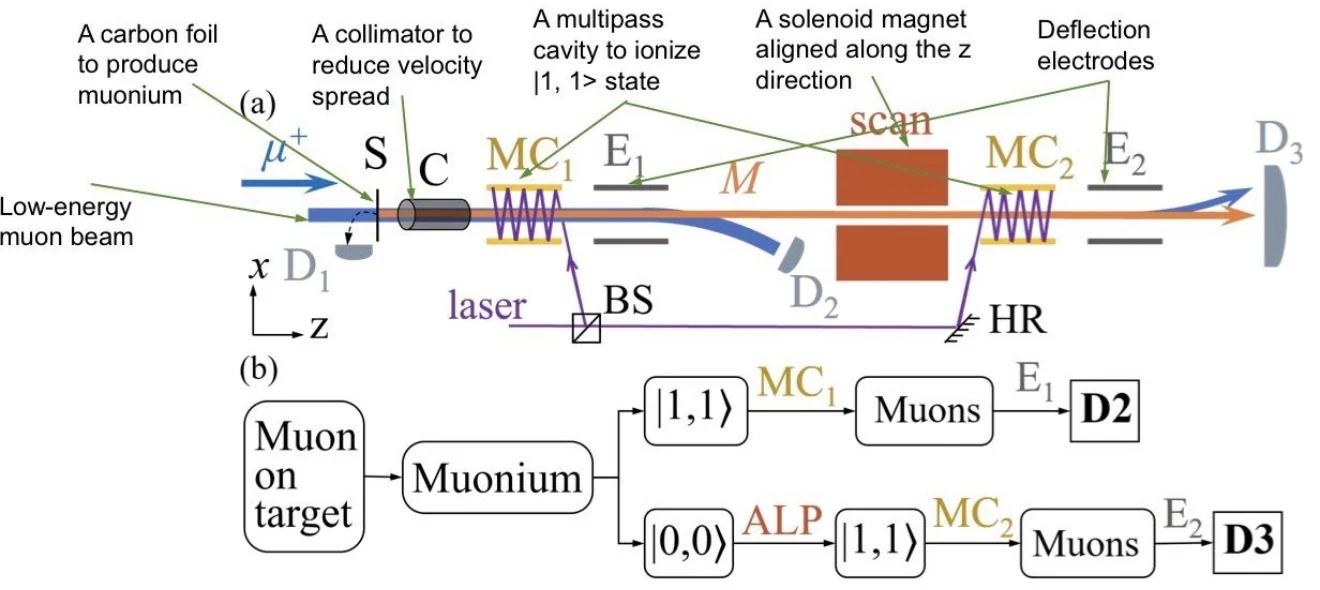
Muonium, the bound state of a positive muon and an electron, has hyperfine levels whose splitting can be tuned with a magnetic field. When that splitting matches the mass of an axion, the oscillating dark matter field can resonantly flip the muonium spin, and the flipped atoms are then detected by laser ionisation. Scanning the magnetic field therefore scans the axion mass. The paper calls the method MASH — a Muonium-based Axion Search through resonant quantum transitions between Hyperfine states.
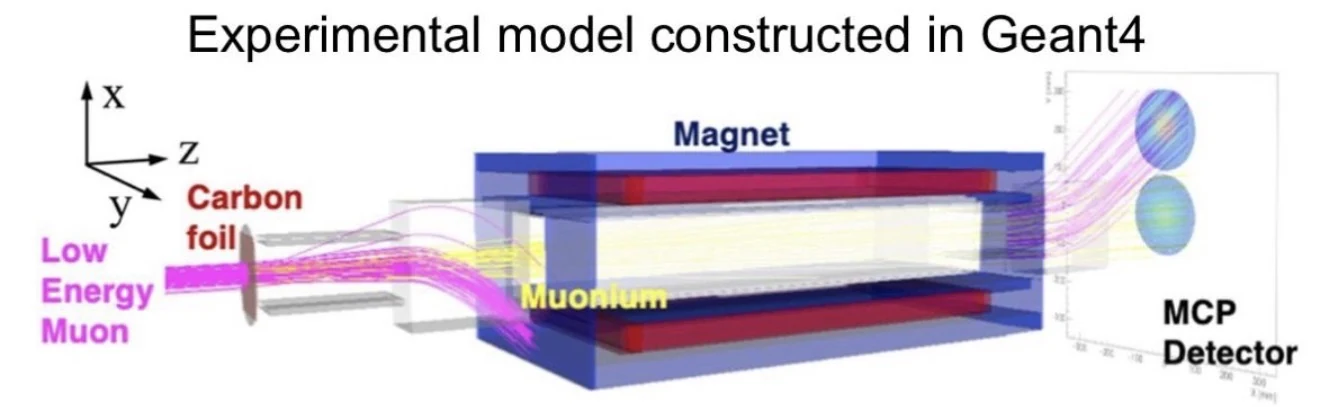
Combining theoretical calculations with simulation, the paper shows that with the high-intensity muon beams coming online at HIMB (PSI) and CiADS (IMP, Huizhou), such an experiment could tighten the constraints on the axion–muon coupling beyond the existing limits from the muon g−2 measurement, for axion masses of 18–130 μeV. It opens a new spectroscopic channel in muonium for axion and axion-like particle dark matter searches.
For Kim the work comes full circle: it draws on the low-energy muon beamlines he worked on during his PhD some 15 years ago. Congratulations to Feng Fang and the team across the Institute of Modern Physics (CAS), Guangdong Laboratory, SJTU, the University of Liverpool and Jinan University. More on the atom itself is on our Muonium page.
课题组论文《Muonium spectroscopy as a quantum sensor for axion dark matter》(利用缪子素谱学作为轴子暗物质量子传感器)于2026年8月18日获Physical Review Letters接收,并于9月10日正式发表(137, 111803, 2026)。📄 阅读论文(预印本:arXiv:2509.20862)。论文作者为Feng Fang、许金祥、Ce Zhang、Qiaoli Yang、Liangwen Chen、Jie Yang、Lei Yang和Zhiyu Sun。
缪子素由一个正缪子和一个电子组成,其超精细能级间隔可由磁场调节。当能级间隔与轴子的静止能量相匹配时,振荡的暗物质场可使缪子素发生共振自旋翻转,再通过激光电离探测这些原子。因此,扫描磁场即可扫描不同的轴子质量。论文将这一方法称为MASH,即利用超精细态之间的共振量子跃迁开展的缪子素轴子搜寻。
结合理论计算与模拟,论文表明,借助PSI的HIMB及中国科学院近代物理研究所惠州CiADS等设施未来提供的高强度缪子束,此类实验有望在18–130 μeV轴子质量范围内,将轴子–缪子耦合的约束推进至现有缪子g−2测量限制之外。这为利用缪子素谱学寻找轴子及类轴子粒子暗物质提供了新的途径。
对许金祥而言,这项研究也延续了他约15年前在博士阶段开展的低能缪子束线工作。祝贺Feng Fang及来自中国科学院近代物理研究所、广东省实验室、上海交通大学、利物浦大学和暨南大学的研究团队。关于缪子素本身的更多介绍,请参阅缪子素科普页面。