The Cosmic-ray Muography System (CMS), developed by the TDLI Muon Physics Group, is now online and has begun taking data in radiography mode. The system consists of three tracking layers, each built from 1.5 cm-wide triangular scintillator bars read out by SiPMs, covering an active area of approximately 50 cm × 50 cm. Combined with CAEN’s A5202 front-end electronics, the CMS provides a compact, modular, high-resolution platform for muon imaging.
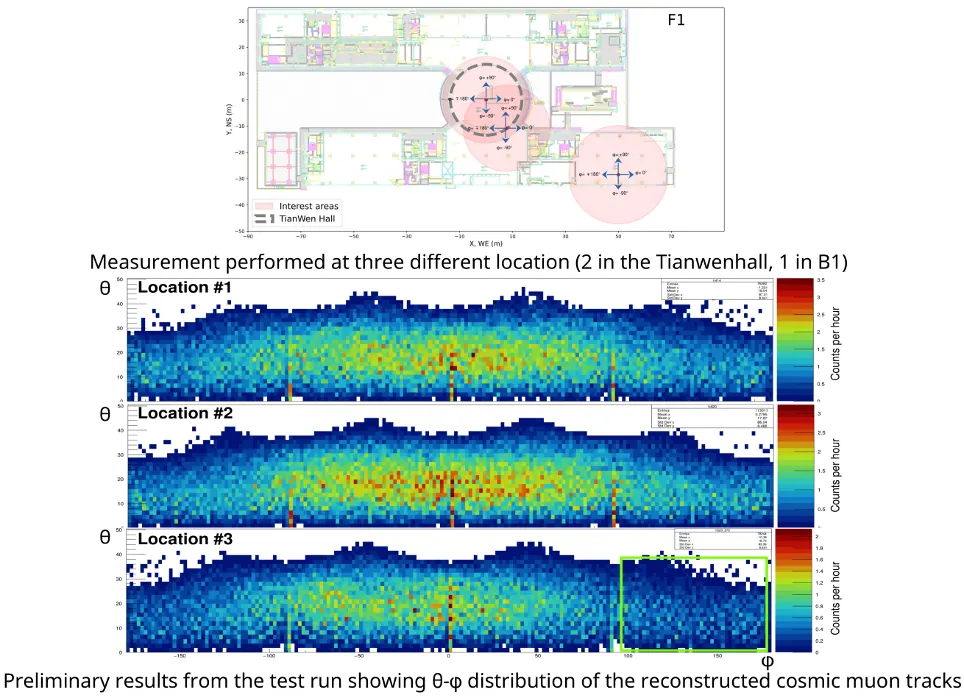
A series of commissioning measurements was carried out at three locations within TDLI: two inside Tianwen Hall and one on the B1 underground level. The preliminary results are promising: the cosmic-ray muon flux in the 90° < φ < 180° range at Location #3 (B1) is significantly lower than at the two surface-level sites. This reduction reflects muons traversing the denser structural material above the underground site, demonstrating the detector’s sensitivity and confirming that it operates properly.
These first measurements are a significant milestone in establishing the CMS as the first functional muography instrument in Shanghai, paving the way for future structural, geological, and subsurface imaging studies around the city.
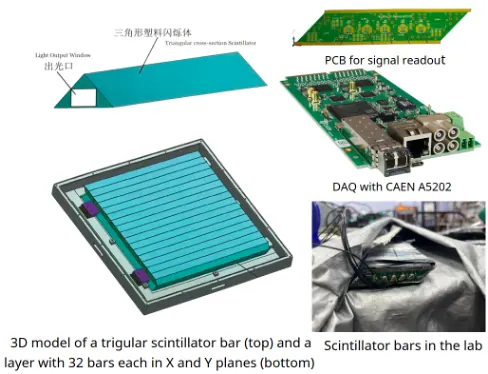
由李政道研究所缪子物理课题组研制的宇宙线缪子成像系统(CMS)现已正式上线,并开始以透射成像模式采集数据。该系统由三层径迹探测层组成,每层由1.5 cm宽的三角形闪烁体条构成,并由硅光电倍增管(SiPM)读出,有效面积约为50 cm × 50 cm。结合CAEN公司的A5202前端电子学,CMS构成了一个紧凑、模块化、高分辨率的缪子成像平台。
课题组在李政道研究所内的三个位置开展了一系列调试测量:两处位于天问堂内,一处位于地下B1层。初步结果令人鼓舞:位置3(B1层)在90° < φ < 180°范围内的宇宙线缪子通量明显低于两个地面位置。这一下降反映了缪子穿越地下位置上方更致密建筑结构的效应,展示了探测器的灵敏度,并证实其运行正常。
这些首批测量是一个重要里程碑,标志着CMS成为上海首台投入运行的缪子成像设备,为今后在上海开展建筑结构、地质及地下成像研究奠定了基础。