R&DResearch研究方向
Research研究方向
Precision muon physics from Fermilab to PSI, a new muon source at SHINE, and muography beneath Shanghai.从费米实验室到PSI的精密缪子物理、SHINE新型缪子源,以及上海地下空间的缪子成像。
We use the muon as a precision probe of fundamental physics, and as a practical tool for seeing inside large structures. Our work spans the full chain: precision measurements at Fermilab and PSI, a new muon source at SHINE in Shanghai, and muography of the city’s underground infrastructure. Our research interests include:我们以缪子作为检验基本物理规律的精密探针,也将其用于探测大型结构内部。研究覆盖从精密测量到实际应用的完整链条:参与费米实验室与PSI的实验,在上海SHINE装置开展新型缪子源设计,并利用缪子成像研究城市地下基础设施。研究兴趣包括:
- Physics beyond the Standard Model超出标准模型的物理
- Anomalous magnetic moments and electric dipole moments反常磁矩与电偶极矩
- Muon production from GeV electron beamGeV电子束驱动的缪子产生
- Muography缪子成像
- Muon cooling and muonium production缪子冷却与缪子素产生
Muon g-2 experiment at Fermilab, USA美国费米实验室Muon g−2实验
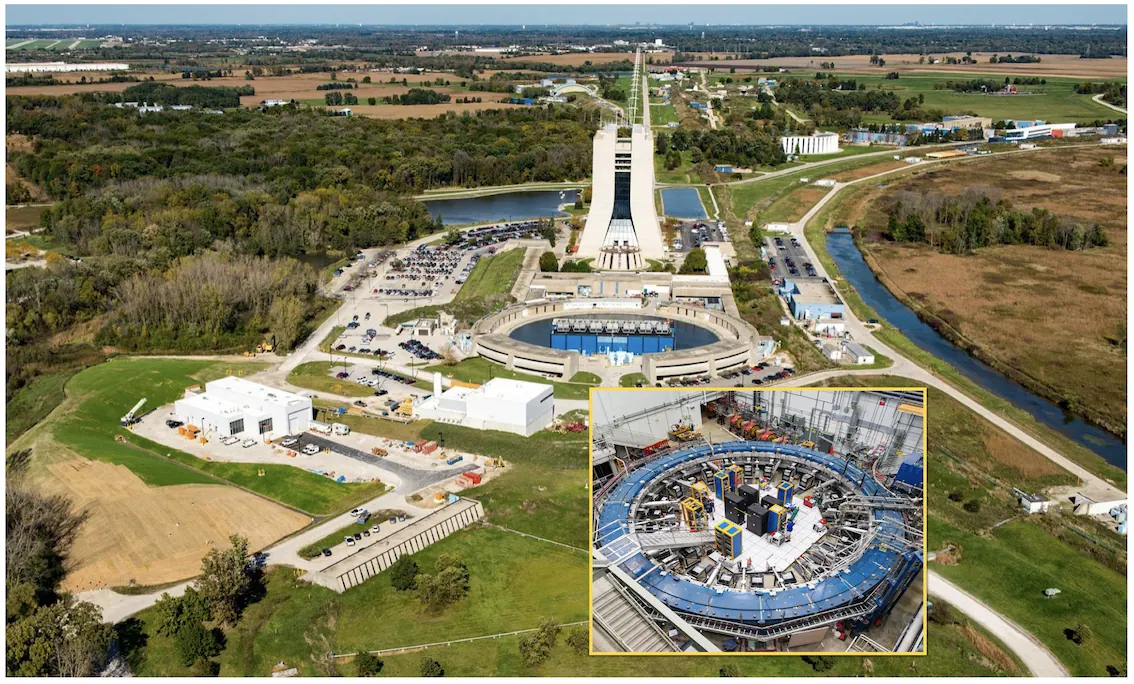
The anomalous magnetic moment of the muon, aμ = (g−2)/2, is one of the most precisely measured and calculated quantities in particle physics, which makes it a sensitive test of the Standard Model (SM). For two decades, the Brookhaven E821 result sat more than three standard deviations above the SM prediction, fuelling models with supersymmetry, dark photons, axion-like particles and more. The Fermilab Muon g-2 Experiment (E989) was built to settle the question with four times better precision. Its final result, released in 2025, reached 127 parts per billion — better than the 140 ppb design goal — and is now the most precise measurement of aμ. Meanwhile, the 2025 SM prediction, which uses lattice-QCD calculations of the hadronic vacuum polarisation, moved into agreement with experiment. Resolving the remaining tension between lattice and data-driven evaluations of that hadronic contribution is now a central task for theory. The same data also set a new direct limit on the muon electric dipole moment. Our group works mainly on the measurement of the anomalous precession frequency ωa and its beam-dynamics corrections.缪子反常磁矩 aμ = (g−2)/2 是粒子物理中测量和计算最精确的物理量之一,也是检验标准模型(SM)的灵敏探针。二十多年来,布鲁克海文E821实验结果与标准模型预言曾相差三个以上标准差,推动了超对称、暗光子和类轴子等新物理研究。费米实验室Muon g−2实验(E989)的目标是将测量精度提高四倍。2025年公布的最终结果达到127 ppb,优于140 ppb的设计目标。与此同时,采用格点量子色动力学计算强子真空极化贡献的2025年标准模型预言与实验结果相符;厘清格点计算与数据驱动方法之间的差异仍是理论研究的重要课题。同一组实验数据还给出了缪子电偶极矩的新直接上限。课题组主要参与反常自旋进动频率ωa的测量及束流动力学修正。
Suggested Reading延伸阅读
- Final Report on the Measurement of the Positive Muon Anomalous Magnetic Moment at Fermilab to 127 ppb, Muon g-2 Collaboration, arXiv:2606.17323 [hep-ex] (2026)
https://arxiv.org/abs/2606.17323 - Measurement of the Positive Muon Anomalous Magnetic Moment to 127 ppb, Muon g-2 Collaboration, Phys. Rev. Lett. 135, 101802 (2025)
https://doi.org/10.1103/7clf-sm2v - Official website for Muon g-2 experiment (E989)
https://muon-g-2.fnal.gov/ - Measurement of the Positive Muon Anomalous Magnetic Moment to 0.20 ppm, Phys. Rev. Lett. 131, 161802 (2023)
https://doi.org/10.1103/PhysRevLett.131.161802 - Measurement of the Positive Muon Anomalous Magnetic Moment to 0.46 ppm, Phys. Rev. Lett. 126, 141801 (2021)
https://doi.org/10.1103/PhysRevLett.126.141801 - Muon g−2: a review, Nucl. Phys. B 975 (2022) 115675
https://doi.org/10.1016/j.nuclphysb.2022.115675 - Muon (g-2) Technical Design Report, J. Grange, et al. (2015)
https://arxiv.org/abs/1501.06858 - Spinning Muons and a Path to Discovery, Phys. Teach. 57, 216–220 (2019)
https://aapt.scitation.org/doi/10.1119/1.5095372 - The Physics of g-2 (Multimedia)
https://www.osti.gov/sciencecinema/biblio/1254328
Muon Electric Dipole Moment search at Paul Scherrer Institut, Switzerland瑞士PSI缪子电偶极矩搜寻
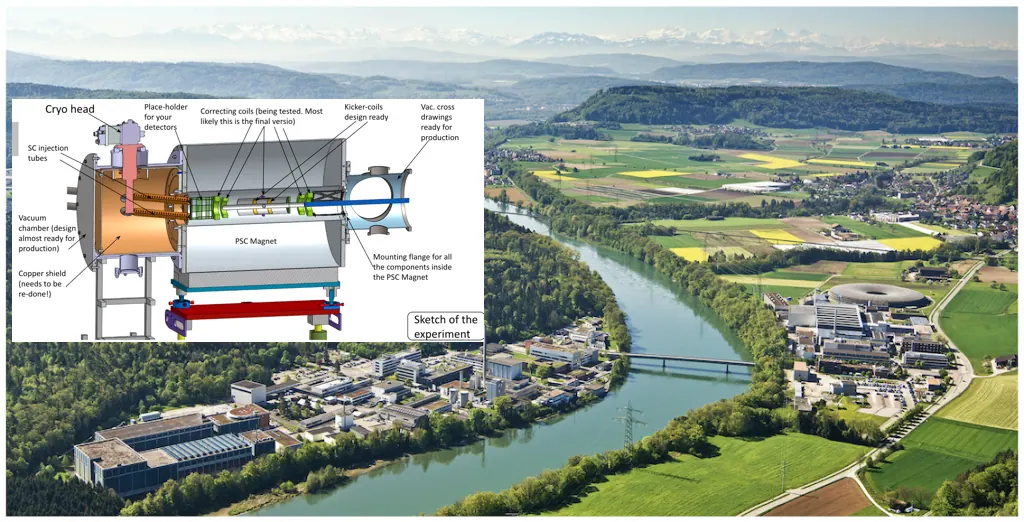
A permanent electric dipole moment (EDM) of an elementary particle violates both time-reversal and charge-parity (CP) symmetry, a key ingredient needed to explain the matter–antimatter asymmetry of the universe. In the Standard Model the muon EDM is around 10−38 e·cm, far beyond any experiment, so any signal would be clear evidence of new physics. Yet many extensions of the Standard Model predict values within reach. The best direct limit, |dμ| < 1.1 × 10⁻¹⁹ e·cm from the Fermilab g-2 storage ring, still leaves the muon EDM one of the least-tested corners of the Standard Model. The muEDM experiment at PSI will use the frozen-spin technique in a compact solenoid storage trap. There, a radial electric field cancels the anomalous spin precession, so that only an EDM can tilt the spin. In the muon rest frame this gives an effective electric field of about 165 MV/m. Phase I aims for a sensitivity of 4 × 10⁻²¹ e·cm, and Phase II for 6 × 10⁻²³ e·cm. Our group designs, builds and tests the muon entrance trigger detector and its fast front-end electronics, which pick out stored muons and fire the kick that holds them in the trap.基本粒子的永久电偶极矩(EDM)破坏时间反演及电荷—宇称(CP)对称性;CP破坏是解释宇宙物质与反物质不对称所需的重要条件之一。标准模型中的缪子电偶极矩约为10−38 e·cm,远低于实验可达范围,因此可观测信号将是新物理的有力证据。许多标准模型扩展预言的数值则可能落在实验灵敏度范围内。费米实验室g−2储存环给出的直接上限为 |dμ| < 1.1 × 10⁻¹⁹ e·cm,缪子EDM仍有很大的探索空间。PSI的muEDM实验将在紧凑螺线管储存装置中采用冻结自旋技术:利用径向电场抵消反常自旋进动,使EDM引起的自旋偏转得以积累。缪子静止系中的有效电场约为165 MV/m。第一阶段和第二阶段的目标灵敏度分别为4 × 10−21 e·cm和6 × 10⁻²³ e·cm。课题组负责设计、研制和测试缪子入射触发探测器及快速前端电子学,以筛选适合储存的缪子并触发注入踢磁场。
Try it live: CHeT Live Tracking — an in-browser muEDM event display in which simulated decay positrons are tracked and helix-fitted in real time.在线演示:CHeT Live Tracking —— 浏览器内的muEDM事例显示,可实时追踪模拟衰变正电子并进行螺旋径迹拟合。
Suggested Reading延伸阅读
- An improved direct limit on the muon electric dipole moment, Muon g-2 Collaboration, arXiv:2608.11124 [hep-ex] (2026)
https://arxiv.org/abs/2608.11124 - Construction and characterization of a muon trigger detector for the PSI muEDM experiment, G.M. Wong et al., Eur. Phys. J. C 86, 911 (2026)
https://doi.org/10.1140/epjc/s10052-026-16145-6 - A compact frozen-spin trap for the search for the electric dipole moment of the muon, A. Adelmann et al., Eur. Phys. J. C 85, 622 (2025)
https://doi.org/10.1140/epjc/s10052-025-14295-7 - Status of the muEDM Experiment at PSI, Phys. Sci. Forum 8 (2023) 1, 50
https://doi.org/10.3390/psf2023008050 - Search for a muon EDM using the frozen-spin technique, A Adelmann et al., arXiv:2102:08838 [hep-ex] (2021)
https://arxiv.org/abs/2102.08838 - Search for the muon electric dipole moment using frozen-spin technique at PSI
https://inspirehep.net/literature/2015643 - Kick-off workshop for the search of a muon EDM using the frozen spin technique at PSI
https://indico.psi.ch/event/8339/ - Combined explanations of (g − 2)_μ,e and implications for a large muon EDM, A. Crivellin et al., Phys. Rev. D 98, 113002 (2018)
https://doi.org/10.1103/PhysRevD.98.113002 - Compact storage ring to search for the muon electric dipole moment, A Adelmann et al., J. Phys. G: Nucl. Part. Phys. 37 085001 (2010)
https://doi.org/10.1088/0954-3899/37/8/085001
Next-generation muon source based on Shanghai SHINE facility基于上海SHINE装置的新一代缪子源
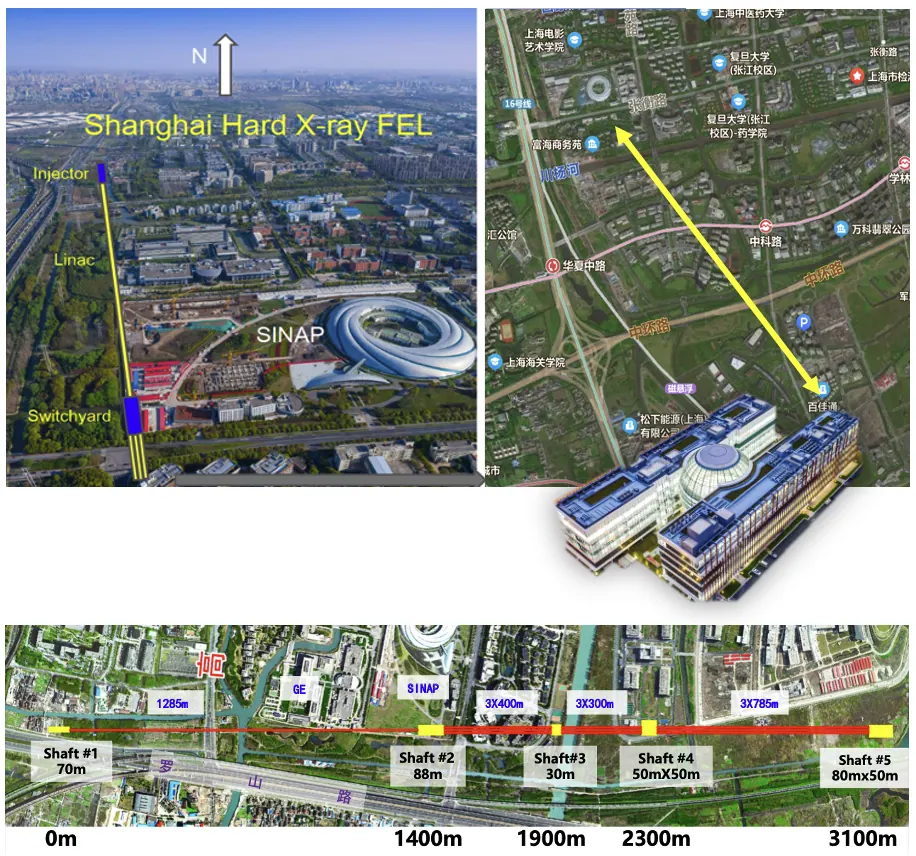
Muons are used across physics, from precision tests of the Standard Model to muon spin rotation (μSR) studies of superconductors and magnetic materials. With a mean lifetime of 2.2 μs, and about ten lifetimes needed per measurement, the ideal pulsed muon source would run near 50 kHz. Today’s sources are either pulsed proton machines at 25–50 Hz (J-PARC, ISIS) or continuous ones (PSI, TRIUMF), which limits the duty cycle for many experiments. We are exploring a different driver: the high-repetition-rate electron beam of SHINE, Shanghai’s hard X-ray free-electron laser. The SHINE design is based on an 8 GeV continuous-wave superconducting linac with bunch rates up to 1 MHz and 100 pC per bunch. Downstream of the undulators, about 1022 electrons a year end up in the beam dump. Our simulations show that these bunches, steered onto a copper target, could deliver about 60 surface muons per bunch to the end of a beamline. At 50 kHz that is 3 × 10⁶ μ+/s, comparable to existing facilities but with a pulse rate a thousand times higher. In the simulations, the same beam also yields a forward component of GeV-scale muons, which opens the door to accelerator-based muography. Simulations with SHINE’s 3 GeV commissioning beam show that a scattering-tomography image of useful quality could be collected in about six hours under the geometry and detector assumptions of that study. These are simulation results, not an operating muon beamline.缪子可用于标准模型精密检验,也可通过缪子自旋旋转(μSR)研究超导体与磁性材料。其平均寿命约为2.2 μs;若一次测量需持续约十个寿命,脉冲重复频率约50 kHz具有吸引力。J-PARC和ISIS等脉冲质子驱动缪子源的重频为25–50 Hz,PSI和TRIUMF则提供连续束流。我们探索另一种驱动方式:利用上海硬X射线自由电子激光装置SHINE的高重频电子束。SHINE采用8 GeV连续波超导直线加速器,设计束团重复频率最高1 MHz、单束团电荷100 pC;电子通过波荡器后进入束流收集器,年电子数约1022。模拟表明,将电子束团引向铜靶,束线末端每个束团可获得约60个表面缪子;在50 kHz下,对应约3 × 10⁶ μ+/s。这是在高脉冲重频下获得可观缪子通量的设计方案,而非已投入运行的缪子束线。电子束还可产生GeV量级前向缪子,为加速器缪子成像提供可能。针对SHINE 3 GeV调试束流的模拟显示,在研究所设定的几何与探测条件下,约六小时可获得具有辨识能力的散射层析图像。
Suggested Reading延伸阅读
- Simulation studies of a high-repetition-rate electron-driven surface muon beamline at SHINE, F. Liu, Y. Takeuchi, S. Chen et al., Phys. Rev. Accel. Beams 28, 083401 (2025)
https://doi.org/10.1103/t2d3-xqnp - Design studies on a kHz–MHz repetition rate pulsed muon source based on electron accelerator, Y. Takeuchi, F. Liu, J. Wang et al., IPAC 2025, TUPM092
https://doi.org/10.18429/JACoW-IPAC2025-TUPM092 - Muon source project at SHINE, Y. Takeuchi, MIP 2024, Beijing
https://indico.cern.ch/event/1356341/contributions/5836913/ - A Pulsed Muon Source Based on a High-Repetition-Rate Electron Accelerator, M. Lv, J. Wang, and K. S. Khaw, IPAC 2023, Venice
https://doi.org/10.18429/JACoW-IPAC2023-TUPA087 - SCLF: An 8-GeV CW SCRF Linac-Based X-Ray FEL Facility in Shanghai, Z. Zhao, D. Wang, Z.-H. Yang, and L. Yin, 38th International Free-Electron Laser Conference, Feb. 2018
https://doi.org/10.18429/JACoW-FEL2017-MOP055 - Towards a dedicated high-intensity muon facility, R. Cywinski et al., Physica B, vol. 404, pp. 1024–1027, 212 (2009)
https://doi.org/10.1016/j.physb.2008.11.203 - Muon Physics Possibilities at the Shanghai SHINE facility, K.S. Khaw, The 2022 Shanghai Particle Physics and Cosmology Symposium, Shanghai
https://indico-tdli.sjtu.edu.cn/event/1309/contributions/5660/
Application of Muography to City Underground Surveys缪子成像在城市地下空间探测中的应用
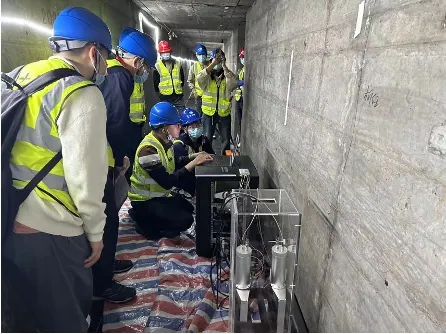
Muography uses cosmic-ray muons, which arrive at about one per square centimetre per minute and can pass through hundreds of metres of rock, to image the inside of large objects without touching them. Absorption muography maps density from how many muons get through; scattering tomography reconstructs material from how much they are deflected. Since 2024, our group has been building compact, portable muon detectors and applying them to the underground spaces of a megacity. In the Shanghai Outer Ring Tunnel, an immersed tube beneath the Huangpu River, our detector recorded a muon rate that rises and falls with the river tide, providing a basis for studying non-invasive monitoring of the material above the tunnel. At TDLI, our three-layer Cosmic-ray Muography System, built from triangular scintillator bars read out by SiPMs, now takes data in radiography mode. In 2026 we took portable detectors abroad for the first time, surveying limestone and karst sites across Peninsular Malaysia. Our muography project also won a First Prize at the 15th “Challenge Cup” Shanghai entrepreneurship competition.缪子成像利用宇宙线产生的缪子来探测大型物体内部。海平面附近的典型缪子通量约为每平方厘米每分钟一个,高能缪子可穿透数百米岩石。吸收成像根据透射通量推断密度,散射层析则利用缪子偏转重建材料分布。自2024年起,课题组研制紧凑便携式探测器,并将其用于超大城市地下空间研究。在黄浦江下方的上海外环沉管隧道中,探测器记录到了随河水潮汐变化的缪子计数率,为进一步研究隧道上覆介质的无损监测提供了依据。在李政道研究所,由三角形闪烁体条和SiPM读出组成的三层宇宙线缪子成像系统已开展透射测量。2026年,我们首次携便携式探测器赴海外,对马来西亚半岛的石灰岩与岩溶场地开展测量。课题组的缪子成像项目还获得了第十五届“挑战杯”上海市大学生创业计划竞赛一等奖。
Try it live: SciFi-MST Live — an interactive 3D simulation of our scintillating-fibre muon scattering tomograph imaging reinforced concrete, with reconstructed scattering-density slices.在线演示:SciFi-MST Live —— 闪烁光纤缪子散射成像系统的交互式三维模拟,展示钢筋混凝土成像及散射密度切片重建。
Suggested Reading延伸阅读
- Simulation study of accelerator-based muography using the GeV-scale forward muon component at SHINE, J. Wang, Y. Wang, S. Chen et al., arXiv:2609.15846 (2026)
https://arxiv.org/abs/2609.15846 - Towards non-invasive sediment monitoring using muography: A pilot run at the Shanghai Outer Ring Tunnel, K.S. Khaw, S.Y. Hoh, T. Hu et al., J. Appl. Phys. 138, 114902 (2025)
https://doi.org/10.1063/5.0273686 - 宇宙射线缪子成像技术在中国的研究进展 Research Progress of Muography in China, K. Yao et al., Chinese Journal of Inorganic Analytical Chemistry,2024,14(6), 715-731
https://doi.org/10.3969/j.issn.2095-1035.2024.06.004 - Muography, Tanaka, H.K.M., Bozza, C., Bross, A. et al., Nat Rev Methods Primers 3 (2023), 88
https://doi.org/10.1038/s43586-023-00270-7 - Deep investigation of muography in discovering geological structures in mineral exploration: a case study of Zaozigou gold mine, G. Liu et al., Geophysical Journal International, Volume 237 1, 588–603 (2024)
https://doi.org/10.1093/gji/ggae057 - Muography: Exploring Earth’s Subsurface with Elementary Particles, László Oláh, Hiroyuki K. M. Tanaka, Dezső Varga, Geophysical Monography Series (2022)
https://www.wiley.com/en-us/Muography%3A+Exploring+Earth’s+Subsurface+with+Elementary+Particles-p-9781119723066 - Muon tomography in geoscientific research – A guide to best practice, Alessandro Lechmann et al., Earth-Science Reviews 222 (2023), 103842
https://doi.org/10.1016/j.earscirev.2021.103842 - Cosmic ray measure overburden of tunnel, E.P. George, Commonwealth Engineer 43, (1955) 455-457
Acknowledgment致谢
We acknowledge research support from the following programmes and funding agencies:感谢以下项目与资助机构对课题组研究的支持:
- MOST National Key R&D Program科技部国家重点研发计划
- Shanghai Pilot Program for Basic Research上海市基础研究特区计划
- NSFC General Program, National Natural Science Foundation of China国家自然科学基金面上项目
- Research Fund for International Young Scientists, NSFC国家自然科学基金外国青年学者研究基金