05/07About Muons缪子科普
Applications of Muons缪子的应用
Muons are not only for testing the laws of physics. Fired into a material, a muon becomes a tiny spy that reports on magnetism deep inside. Captured by an atom, it makes the atom sing a characteristic X-ray note. Bound into a molecule, it can even make nuclei fuse. This chapter tours the practical uses of muons, from quantum materials and batteries to Roman coins and asteroid dust.
缪子并不只用于检验物理定律。射入材料后,缪子就成了一名微型“侦察兵”,报告材料深处的磁性信息;被原子俘获后,它会让原子“唱”出特征X射线;结合进分子中,它甚至能促使原子核发生聚变。本章将带你了解缪子的实际用途——从量子材料、电池,到古罗马钱币和小行星尘埃。
Muon spin spectroscopy (μSR)缪子自旋谱学(μSR)
A compass needle inside the material放进材料内部的指南针
μSR stands for muon spin rotation, relaxation and resonance. A beam of fully spin-polarised positive muons is fired into a sample, where each muon stops at a site between the atoms. If there is a local magnetic field there, the muon's spin precesses around it like a compass needle swinging. About 2.2 μs later the muon decays, and its positron flies off preferentially along the spin direction. By recording millions of these positrons with detectors around the sample, scientists reconstruct how the spins turned — and so measure the magnetic fields, and how they fluctuate, at the atomic scale.
μSR 是缪子自旋旋转、弛豫与共振的统称。将完全自旋极化的正缪子束射入样品,每个缪子会停在原子之间的某个位置。若该处存在局部磁场,缪子自旋就会像指南针摆动一样绕磁场进动。约2.2微秒后缪子衰变,其正电子倾向于沿自旋方向飞出。通过样品周围的探测器记录数百万个正电子,科学家就能重建自旋的转动过程,从而在原子尺度上测量磁场及其涨落。
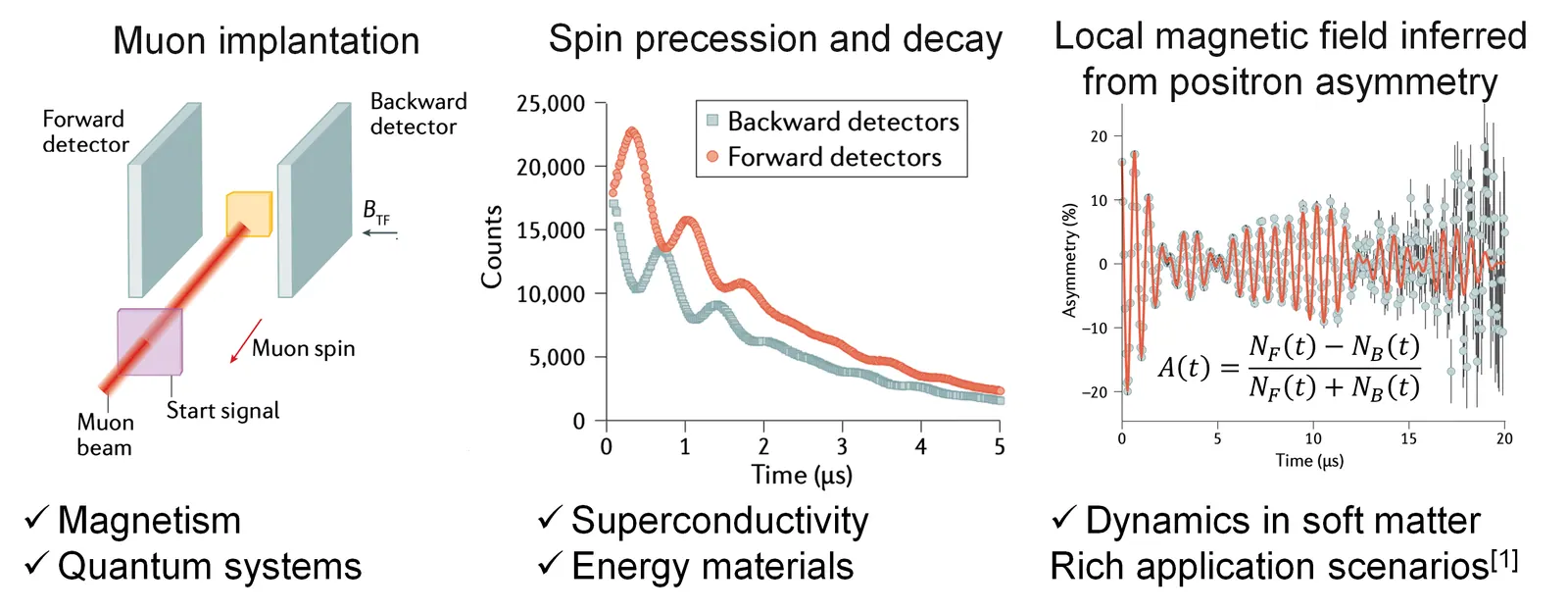
What makes μSR special is that it needs no external probe field, works in any kind of sample — crystals, powders, thin films, even liquids — including in zero applied field, and is sensitive to very weak and very fast-changing magnetism that other techniques miss.
μSR 的独特之处在于:无需外加探测场,适用于任何材料——晶体、粉末、液体,甚至零磁场环境——并且对其他技术难以探测的极弱、极快变化的磁性高度敏感。
What μSR is used forμSR 的应用
- Superconductors: measuring how deep magnetic fields penetrate (the penetration depth) and whether a superconductor breaks time-reversal symmetry — key clues to how unconventional superconductors work.
- 超导体:测量磁场穿透深度,以及超导体是否破坏时间反演对称性——这是理解非常规超导机制的关键线索。
- Quantum magnets: detecting tiny ordered moments and slow spin fluctuations in frustrated magnets and candidate quantum spin liquids.
- 量子磁体:探测阻挫磁体和量子自旋液体候选材料中极微弱的有序磁矩与缓慢的自旋涨落。
- Energy materials: watching lithium and sodium ions hop through battery electrodes, and hydrogen diffuse in storage materials.
- 能源材料:观察锂、钠离子在电池电极中的跳跃,以及氢在储氢材料中的扩散。
- Semiconductors: a muon can grab an electron to form muonium, which mimics an isolated hydrogen atom — the most important and hardest-to-study impurity in semiconductors.
- 半导体:缪子可以俘获电子形成缪子素,模拟孤立的氢原子——这是半导体中最重要却最难研究的杂质。
- Soft matter and chemistry: following radicals and molecular dynamics in polymers, liquids and biological molecules.
- 软物质与化学:追踪聚合物、液体和生物分子中的自由基与分子动力学过程。
Two examples from recent research:
两个近期研究实例:
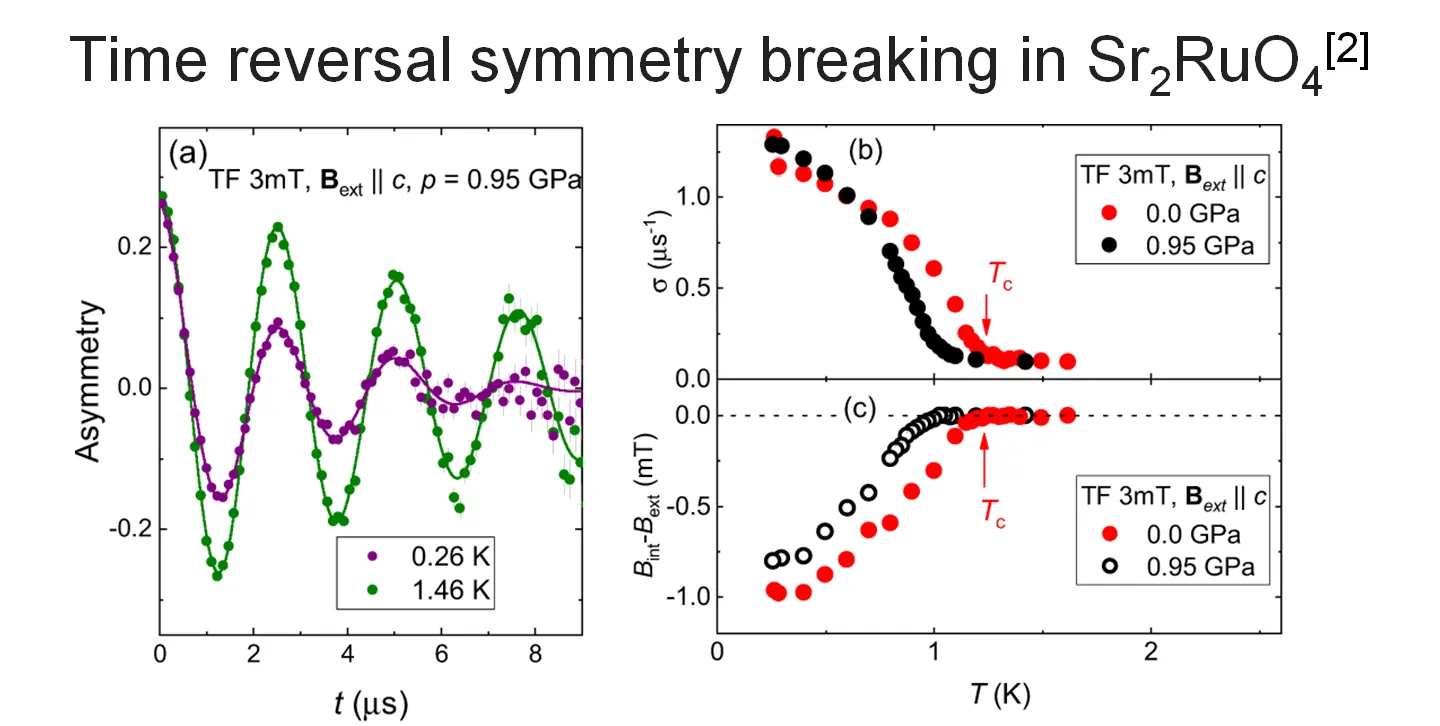
Time-reversal symmetry breaking in Sr2RuO4, a long-debated unconventional superconductor, studied under uniaxial strain.
Sr2RuO4 中的时间反演对称性破缺——在单轴应力下研究这一长期存在争议的非常规超导体。
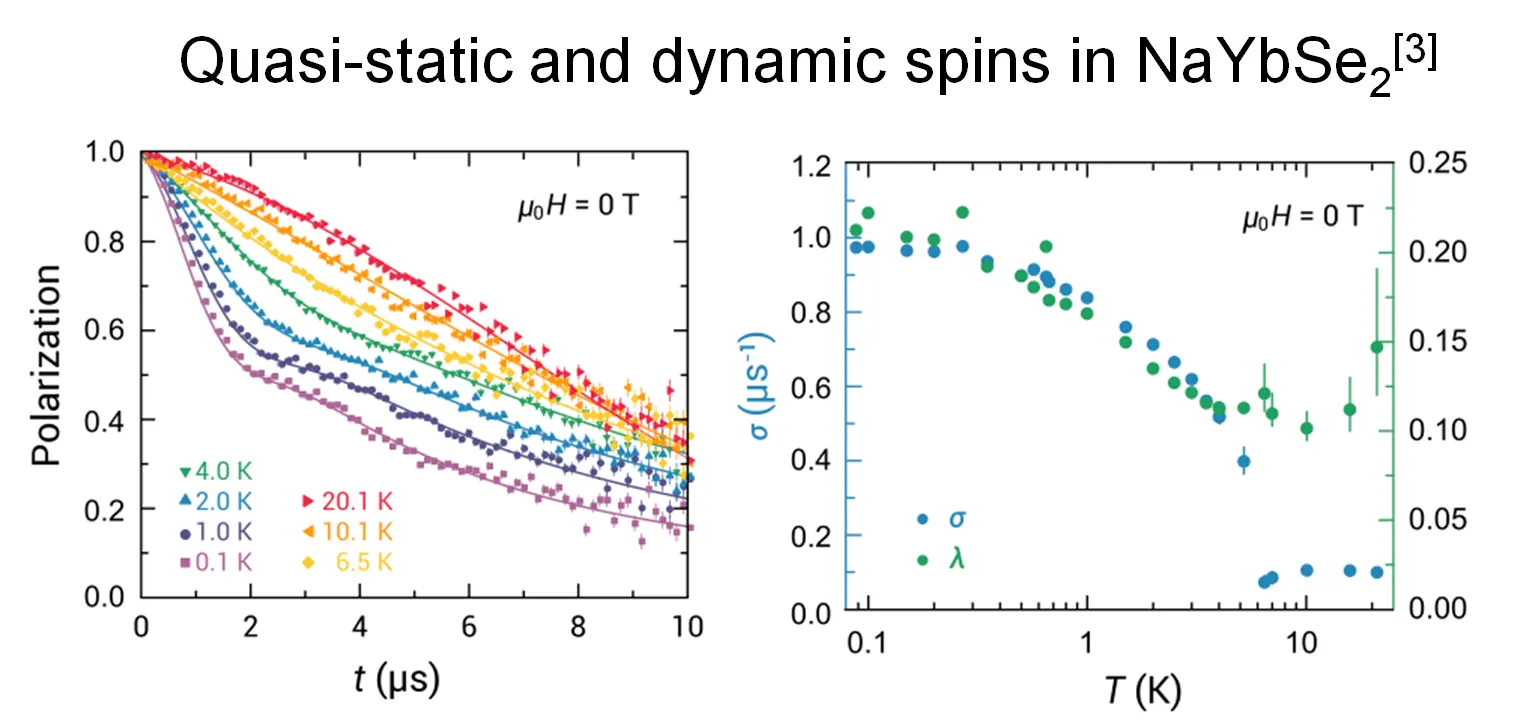
Quasi-static and dynamic spins in NaYbSe2, a candidate quantum spin liquid on a triangular lattice.
NaYbSe2 中的准静态与动态自旋——一种三角晶格量子自旋液体候选材料。
Muon-induced X-ray emission (MIXE)缪子诱发X射线发射(MIXE)
An atom's X-ray fingerprint原子的X射线“指纹”
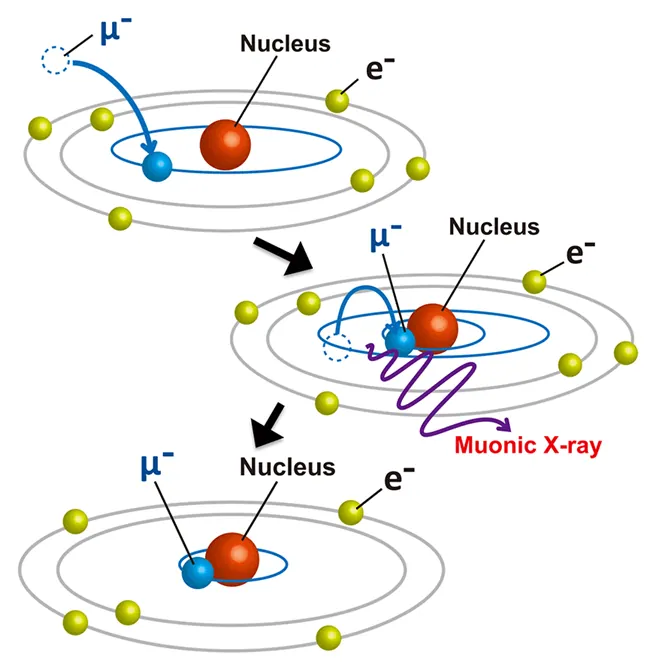
When a negative muon is slowed down in a material, an atom captures it in a high orbit. The muon then cascades down to the lowest orbit in less than a nanosecond, emitting X-rays at each step. Because the muon is 207 times heavier than an electron, these “muonic X-rays” are about 200 times more energetic than ordinary X-rays — tens of keV up to several MeV — and their energies are a unique fingerprint of the element.
负缪子在材料中慢化后,会被原子俘获到高能级轨道上,随后在不到一纳秒的时间内逐级跃迁到最低轨道,每一步都发射X射线。由于缪子比电子重207倍,这些“缪子X射线”的能量比普通X射线高约200倍——从几十keV到几MeV——其能量是元素独一无二的“指纹”。
- Non-destructive: the high-energy X-rays escape even from deep inside an object, so nothing has to be cut or sampled.
- 无损:高能X射线即使从物体深处也能逃逸出来,因此无需切割或取样。
- All elements at once: light elements such as carbon, nitrogen and oxygen can be measured alongside heavy metals.
- 多元素同时分析:碳、氮、氧等轻元素可以与重金属同时测量。
- Depth profiling: the muon's momentum sets how deep it stops, so scientists can scan from micrometres to centimetres below the surface.
- 深度剖析:缪子的动量决定其停止深度,因此可以从表面以下几微米到几厘米逐层扫描。
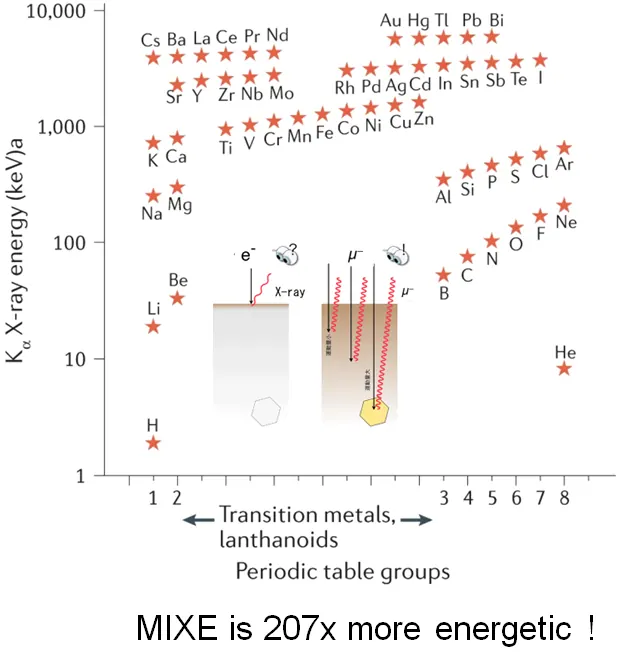
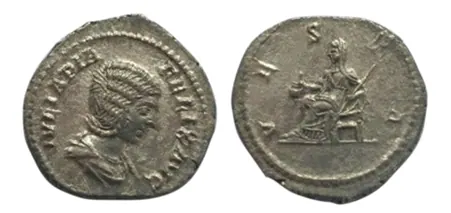
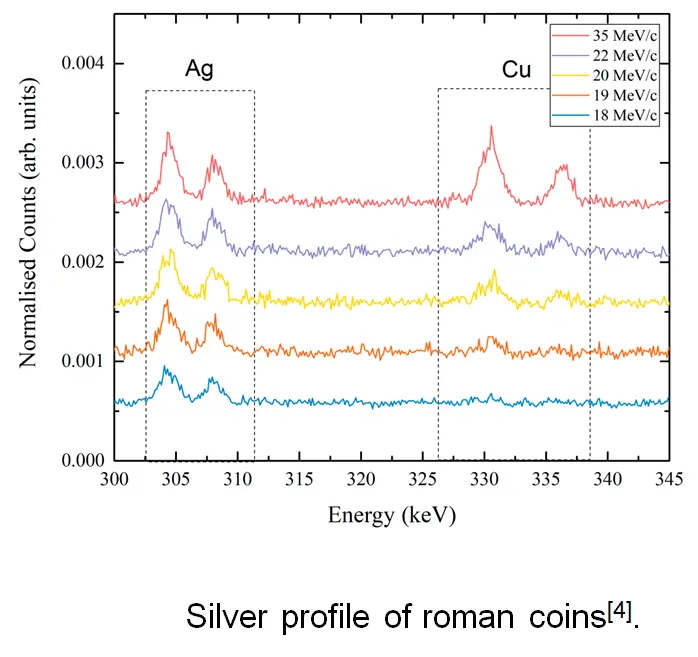
MIXE has been used to study silver Roman coins and bronze artefacts without damaging them, to analyse meteorites, and to measure the composition of tiny grains returned from asteroid Ryugu by the Hayabusa2 mission. It is also used to check lithium distribution inside working batteries.
MIXE 已被用于在不损坏的前提下研究古罗马银币和青铜器、分析陨石,以及测定“隼鸟2号”从小行星“龙宫”带回的微小颗粒成分,还可用于检测工作中电池内部的锂分布。
Muon-catalysed fusion (μCF)缪子催化核聚变(μCF)
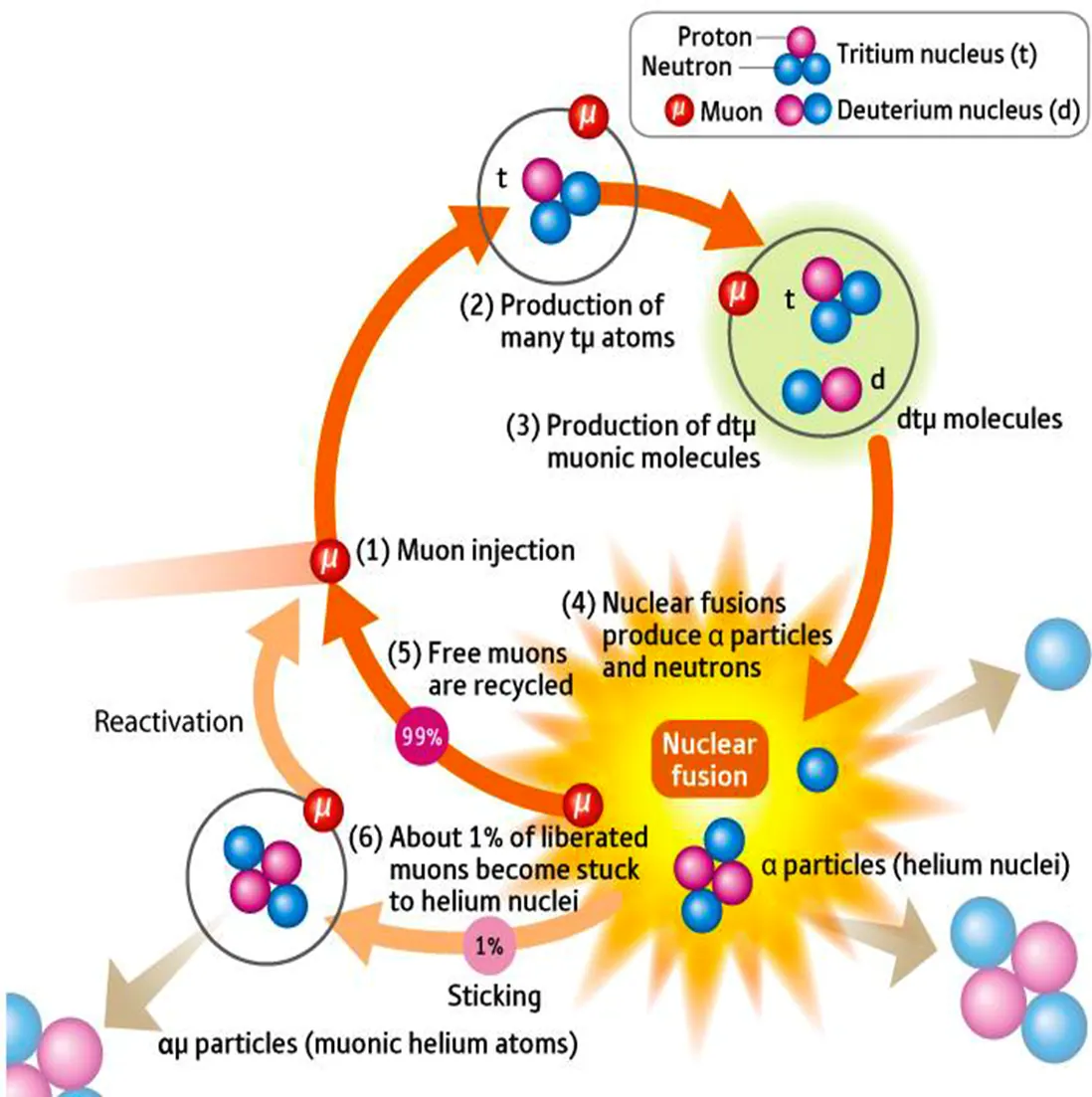
Nuclear fusion normally needs temperatures of a hundred million degrees, so that nuclei collide hard enough to overcome their electric repulsion. A muon offers a different route. If a negative muon replaces the electron in a molecule of deuterium and tritium, the molecule shrinks about 200 times and the two nuclei sit so close together that they fuse within about a picosecond — at room temperature. The muon is usually released and can catalyse another fusion.
核聚变通常需要上亿摄氏度的高温,才能让原子核以足够大的能量碰撞、克服彼此之间的电排斥。缪子提供了另一条途径:如果用负缪子替换氘—氚分子中的电子,分子会缩小约200倍,两个原子核靠得极近,在约一皮秒内就会发生聚变——而且是在室温下。缪子通常会被释放出来,继续催化下一次聚变。
- History: predicted by Andrei Sakharov and Charles Frank in the late 1940s, and first seen by Luis Alvarez's group in a hydrogen bubble chamber in 1956.
- 历史:20世纪40年代末由萨哈罗夫与弗兰克(Charles Frank)预言,1956年由阿尔瓦雷茨团队在氢气泡室中首次观测到。
- The catch: one muon can catalyse roughly 100–150 fusions before it decays or sticks to a helium nucleus (“α-sticking”). Making a muon costs more energy than those fusions release, so μCF is not yet a power source.
- 瓶颈:一个缪子在衰变或“粘附”到氦核上(α粘附)之前,大约能催化100—150次聚变。而产生一个缪子所消耗的能量多于这些聚变释放的能量,因此μCF目前还不能作为能源。
- Today: research focuses on increasing the number of cycles per muon, new reaction mechanisms, and using μCF as a compact source of fusion neutrons or slow muons.
- 现状:研究重点包括提高每个缪子的催化次数、探索新的反应机制,以及将μCF用作紧凑的聚变中子源或慢缪子源。
Other uses其他应用
- Muography — imaging pyramids, volcanoes, tunnels and cargo with cosmic muons. See the Muography Applications chapter.
- 缪子成像——利用宇宙线缪子对金字塔、火山、隧道和货物进行成像,详见缪子成像应用一章。
- Reliability of electronics — as chips shrink, a single cosmic muon can flip a bit in memory. Muon beams are used to test how often this happens.
- 电子器件可靠性——随着芯片尺寸不断缩小,单个宇宙线缪子就可能导致存储器比特翻转。缪子束被用来测试这类“软错误”的发生频率。
- Cosmic-ray monitoring — networks of muon detectors track changes in the cosmic-ray flux caused by solar activity and the atmosphere.
- 宇宙线监测——缪子探测器网络可以追踪太阳活动和大气变化引起的宇宙线通量变化。
References参考文献
- A. D. Hillier et al., “Muon spin spectroscopy,” Nat. Rev. Methods Primers 2, 4 (2022). doi:10.1038/s43586-021-00089-0
- V. Grinenko et al., “Unsplit superconducting and time reversal symmetry breaking transitions in Sr₂RuO₄ under hydrostatic pressure and disorder,” Nat. Commun. 12, 3920 (2021). arXiv:2103.03600
- Z. Zhu et al., “Fluctuating magnetic droplets immersed in a sea of quantum spin liquid,” The Innovation 4, 100459 (2023). arXiv:2112.06523
- B. V. Hampshire et al., “Using negative muons as a probe for depth profiling silver Roman coinage,” Heritage 2, 400 (2019). doi:10.3390/heritage2010028
- T. Nakamura et al., “Formation and evolution of carbonaceous asteroid Ryugu: direct evidence from returned samples,” Science 379, eabn8671 (2023). doi:10.1126/science.abn8671
- L. W. Alvarez et al., “Catalysis of nuclear reactions by μ mesons,” Phys. Rev. 105, 1127 (1957). doi:10.1103/PhysRev.105.1127
- T. Yamashita et al., “Roles of resonant muonic molecule in new kinetics model and muon catalyzed fusion in compressed gas,” Sci. Rep. 12, 6393 (2022). doi:10.1038/s41598-022-09487-0